Black-tailed Gull

Black-tailed Gull

Larus crassirostris

Silhouette: Sharon Wegner-Larsen · PhyloPic

LCLeast ConcernNTVUENCR
Daily sighting probability ~20% · Possible
at Kitakyushu

In 3 days ~40% in a week ~70%

10 Verified sightings at Kitakyushu
September Best month
☀️ Diurnal When it's spotted

About the Black-tailed Gull

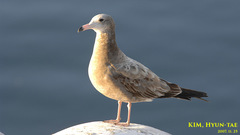
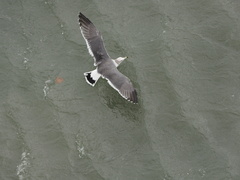
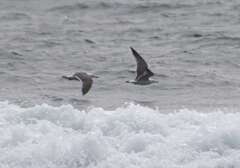
The black-tailed gull (Larus crassirostris) is a gull native to shorelines of East Asia. The black-tailed gull is medium-sized (46 cm or 18.1 in), with a wingspan of 126–128 cm (49.6–50.4 in). It has yellow legs and a red and black spot at the end of the bill. Males and females have identical plumage and features, although males are larger in size than females. This gull takes four years to reach full adult plumage. As the name suggests, it has a black tail. The bird has a cat-like call, giving it its Japanese name — umineko (海猫, 'sea cat'), and Korean name — gwaeng-yi gull, which means 'cat' gull. In Hachinohe their calls are one of the 100 Soundscapes of Japan.

The species is resident to coastlines of the East China Sea, Japan, Manchuria and the Kuril Islands. It is a vagrant to Alaska and North America and has been found in the Philippines. The bird is common in Japan, nesting from Hokkaido to Western Kyushu. It has caused flights to be delayed at Haneda Airport in Tokyo.

An enormous gathering of black-tailed gulls can be found at Kabushima, a peninsula (formerly an island) in Hachinohe, Aomori, Japan. A Shinto shrine... Wikipedia →

Sounds

Call0:08

China · 2025

© Bo Shunqi 薄顺奇 · XC1101470 · CC BY-NC-SA 4.0

Call0:27

Japan · 2025

© Uku Paal · XC1016634 · CC BY-NC-SA 4.0

Call0:17

South Korea · 2014

© Stuart Fisher · XC787497 · CC BY-NC-SA 4.0

Global Distribution

Parks Where Found

# Park Country Daily sighting probability

More parks will be added in future updates.

Cities Where Found

# City Country Daily sighting probability
1 Busan 🇰🇷 South Korea
~60%
2 Dalian 🇨🇳 China
~40%
3 Qingdao 🇨🇳 China
~20%
4 Đà Nẵng 🇻🇳 Vietnam
~20%
5 Kitakyushu 🇯🇵 Japan
~20%
6 Tokyo 🇯🇵 Japan
~20%
7 Seoul 🇰🇷 South Korea
~10%
8 Hiroshima 🇯🇵 Japan
~10%
9 Fukuoka 🇯🇵 Japan
~10%
10 Nagoya 🇯🇵 Japan
~10%

Zoos & Centres Where Found

# Zoo / Centre Country
1 Zhuhai Chimelong Ocean Kingdom 🇨🇳 China In captivity
2 Chimelong Spaceship 🇨🇳 China In captivity
3 Tierpark Berlin 🇩🇪 Germany In captivity
4 Zoorasia 🇯🇵 Japan In captivity
5 Walsrode World Bird Park 🇩🇪 Germany In captivity
6 Beijing Zoo 🇨🇳 China In captivity
7 Beijing Aquarium 🇨🇳 China In captivity

Before you go

What are the chances of seeing a Black-tailed Gull in Kitakyushu?

Possible

About 20% of wildlife watchers report a Black-tailed Gull sighting in Kitakyushu on a given day, based on 10 verified sightings from GBIF citizen-science data. It is the 15th most-seen of the 39 birds we can rate there. Over three days the chance rises to about 40%, and over a week to about 70%, if each day is a fresh chance.

When is the best time to see a Black-tailed Gull in Kitakyushu?

February and September–December

In those months about 20% of wildlife watchers report a Black-tailed Gull in Kitakyushu on a given day, against about 10% in March to May, the lowest months. January and June–August have too few records to rate.

What time of day is best to see a Black-tailed Gull?

Between 9 am and noon

Across all the parks we cover, that three-hour window holds the most Black-tailed Gull sightings with a recorded time, and about 9 in 10 of them come between 6 am and 6 pm: it is a daytime animal.

Is Kitakyushu the best place to see a Black-tailed Gull?

5th of 20

Of the 20 cities where we can rate Black-tailed Gull sightings, Kitakyushu ranks 5th at about 20%. The best odds are in Busan (South Korea, about 60%), Dalian (China, about 40%) and Qingdao (China, about 20%).

Which relatives of the Black-tailed Gull live in Kitakyushu?

Same order: Charadriiformes

The closest relatives of the Black-tailed Gull that you can see in Kitakyushu (order Charadriiformes, Shorebirds and Allies) are Common Sandpiper (about 20%), Common Greenshank (about 10%) and European Oystercatcher (about 10%), with each one's daily chance of a sighting.

Where does the Black-tailed Gull sighting chance come from?

GBIF citizen-science records

It is estimated from how often the Black-tailed Gull is recorded against all the birds logged in Kitakyushu (10 verified sightings), calibrated against known sighting rates. Figures are rounded to the nearest 10% because citizen-science data supports honest approximations, not decimals, and months with records from fewer than five people show "—". How it works.

← Back to Kitakyushu