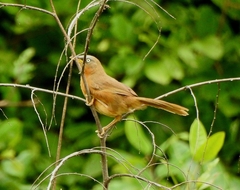
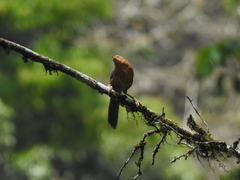
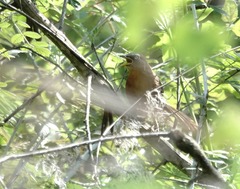
Rufous Babbler

Rufous Babbler

Turdoides subrufa

Silhouette: Jiekun He · PhyloPic

Daily sighting probability <5% · Rare
at Kochi

In 3 days <5%

6 Verified sightings at Kochi
654 In all 5 parks From 2019 to 2026
April Best month
🌅 Crepuscular When it's spotted

About the Rufous Babbler

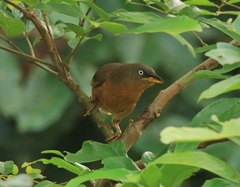
The rufous babbler (Argya subrufa) is an endemic species of bird found in the Western Ghats of southern India of the family Leiothrichidae It is dark brown and long tailed, and is usually seen foraging in noisy groups along open hillsides with a mixture of grass, bracken and forest.

The rufous babbler was formerly placed in the genus Turdoides but following the publication of a comprehensive molecular phylogenetic study in 2018, it was moved to the resurrected genus Argya. This babbler is large and dark olive brown above with a grey forehead. The wing feathers have a rufous tinge. The feathers of the forehead have black shafts. The iris is pale white to yellow and the lores are dark. The underside is bright rufous, and paler on the center of the throat and belly. The nominate form (type location: Mananthawadi) is found in the Western Ghats north of the Palghat Gap while hyperythra found to the south is said to be more richly coloured. They are 25–26 cm long with a wing of 8.7-9.0 cm. The tail is about 11–11.5 cm long.

This species is found in the Western Ghats south of Mahabaleshwar south to the Palni hills and east into... Wikipedia →

Sounds

Recording0:09

India · 2025

© Gaurav S. Soman. · iNaturalist · CC BY-NC 4.0

Global Distribution

Parks Where Found

# Park Country Daily sighting probability
1 Periyar National Park 🇮🇳 India
~20%
2 Eravikulam National Park 🇮🇳 India
<5%
3 Nagarhole National Park 🇮🇳 India
<5%
4 Bandipur National Park 🇮🇳 India
<5%
5 Mudumalai National Park 🇮🇳 India
<5%

Cities Where Found

# City Country Daily sighting probability
1 Kozhikode 🇮🇳 India
<5%
2 Kochi 🇮🇳 India
<5%

Before you go

What are the chances of seeing a Rufous Babbler in Kochi?

Rare

Under 5% of wildlife watchers report a Rufous Babbler sighting in Kochi on a given day, based on 6 verified sightings from GBIF citizen-science data. It is the 231st most-seen of the 235 birds we can rate there. Over three days the chance rises to under 5%, if each day is a fresh chance.

When is the best time to see a Rufous Babbler in Kochi?

Any time of year

In every month with enough records, under 5% of wildlife watchers report a Rufous Babbler in Kochi on a given day, so our monthly data shows no clear season.

What time of day is best to see a Rufous Babbler?

Between 3 and 6 am

Across all the parks we cover, that three-hour window holds the most Rufous Babbler sightings with a recorded time, and about 6 in 10 of them come between 6 am and 6 pm: it is most active around dawn and dusk.

Is Kochi the best place to see a Rufous Babbler?

Among the best

Of the 2 cities where we can rate Rufous Babbler sightings, Kochi ranks 2nd at under 5%, level with the leaders once rounded. The best odds are in Kozhikode (India, under 5%).

Which relatives of the Rufous Babbler live in Kochi?

Same genus: Turdoides

The closest relatives of the Rufous Babbler that you can see in Kochi (genus Turdoides, Turdoides Babblers) are Jungle Babbler (about 10%) and Yellow-billed Babbler (about 10%), with each one's daily chance of a sighting.

Where does the Rufous Babbler sighting chance come from?

GBIF citizen-science records

It is estimated from how often the Rufous Babbler is recorded against all the birds logged in Kochi (6 verified sightings), calibrated against known sighting rates. Figures are rounded to the nearest 10% because citizen-science data supports honest approximations, not decimals, and months with records from fewer than five people show "—". How it works.

← Back to Kochi