
Indian Wolf Snake

Indian Wolf Snake

Lycodon aulicus

Silhouette: Alex Slavenko · PhyloPic

LCLeast ConcernNTVUENCR
Daily sighting probability ~10% · With luck
at Kolkata

In 3 days ~30% in a week ~60%

9 Verified sightings at Kolkata
6 In 1 park From 2019 to 2026
July Best month
🌅 Crepuscular When it's spotted

About the Indian Wolf Snake

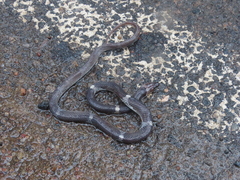
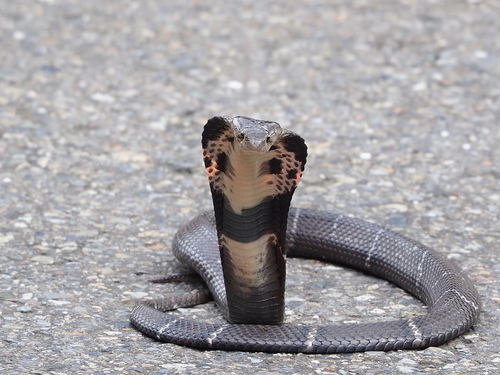
Lycodon aulicus, commonly known as the Indian wolf snake and the common wolf snake, is a species of nonvenomous snake in the subfamily Colubrinae of the family Colubridae. The species is native to South Asia and Southeast Asia. Early naturalists suggested its resemblance to the venomous common krait, an instance of Batesian mimicry.

The colouration of this snake is variable. This snake is often confused with the common krait. The presence of a loreal shield can be used to distinguish it from kraits. The following is a description of various forms from Albert Günther's Reptiles of British India (1864).

Snout broad, much depressed, long, spatulate, with the upper lip swollen, and without canthus rostralis. Rostral shield very low, broad, slightly bent backwards on the upper surface of the snout; anterior frontals [= internasals] very small; posterior frontals [= prefrontals] longer than broad, much more so in adult specimens than in young ones; there is a lateral notch between the anterior and posterior frontals, in which the inner anterior angle of the loreal is received; the posterior frontals have an obtuse lateral angle corresponding to the suture between loreal... Wikipedia →

Global Distribution

Parks Where Found

# Park Country Daily sighting probability
1 Kanha National Park 🇮🇳 India
~20%

More parks will be added in future updates.

Cities Where Found

# City Country Daily sighting probability
1 Lucknow 🇮🇳 India
~50%
2 Chattogram 🇧🇩 Bangladesh
~50%
3 Thrissur 🇮🇳 India
~30%
4 Raipur 🇮🇳 India
~30%
5 Guwahati 🇮🇳 India
~20%
6 Pune 🇮🇳 India
~20%
7 Kolkata 🇮🇳 India
~10%
8 Mumbai 🇮🇳 India
~10%
9 New Delhi 🇮🇳 India
~10%

Zoos & Centres Where Found

# Zoo / Centre Country
1 Thiruvananthapuram Zoo 🇮🇳 India In captivity

Before you go

What are the chances of seeing an Indian Wolf Snake in Kolkata?

With luck

About 10% of wildlife watchers report an Indian Wolf Snake sighting in Kolkata on a given day, based on 9 verified sightings from GBIF citizen-science data. It is the 9th most-seen of the 14 reptiles we can rate there. Over three days the chance rises to about 30%, and over a week to about 60%, if each day is a fresh chance.

When is the best time to see an Indian Wolf Snake in Kolkata?

July

In that month about 30% of wildlife watchers report an Indian Wolf Snake in Kolkata on a given day, against under 5% in June, August–September and December–February, the lowest months. That is one of Kolkata's wettest months, with about 330 mm of rain against 10 mm in December.

What time of day is best to see an Indian Wolf Snake?

Between 4 and 7 pm

Across all the parks we cover, that three-hour window holds the most Indian Wolf Snake sightings with a recorded time, and about 6 in 10 of them come between 6 am and 6 pm: it is most active around dawn and dusk.

Is Kolkata the best place to see an Indian Wolf Snake?

7th of 9

Of the 9 cities where we can rate Indian Wolf Snake sightings, Kolkata ranks 7th at about 10%. The best odds are in Lucknow (India, about 50%), Chattogram (Bangladesh, about 50%) and Thrissur (India, about 30%).

Which relatives of the Indian Wolf Snake live in Kolkata?

Same family: Colubridae

The closest relatives of the Indian Wolf Snake that you can see in Kolkata (family Colubridae, Colubrid Snakes) are Chequered Keelback (about 30%), Dhaman (about 20%) and Common Bronzeback Tree Snake (about 10%), with each one's daily chance of a sighting.

Where does the Indian Wolf Snake sighting chance come from?

GBIF citizen-science records

It is estimated from how often the Indian Wolf Snake is recorded against all the reptiles logged in Kolkata (9 verified sightings), calibrated against known sighting rates. Figures are rounded to the nearest 10% because citizen-science data supports honest approximations, not decimals, and months with records from fewer than five people show "—". How it works.

← Back to Kolkata