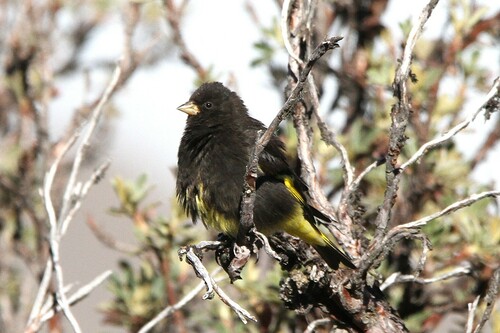
Andean Flicker

Andean Flicker

Colaptes rupicola

Silhouette: Edwin Price · PhyloPic

LCLeast ConcernNTVUENCR
Daily sighting probability ~40% · Likely
at La Paz

In 3 days ~80% in a week >90%

141 Verified sightings at La Paz
408 In 1 park From 2019 to 2026
January Best month
☀️ Diurnal When it's spotted

About the Andean Flicker

The Andean flicker (Colaptes rupicola) is a species of bird in subfamily Picinae of the woodpecker family Picidae. It is found in Argentina, Bolivia, Chile, Ecuador, and Peru. The Andean flicker was for a time placed in genus Soroplex that was later merged into Colaptes. It and the Chilean flicker (C. pitius) are sister species.

BirdLife International's Handbook of the Birds of the World includes puna with the nominate as the "southern Andean flicker" and treats cinereicapillus as the separate species "northern Andean flicker". This article follows the three-subspecies model.

The Andean flicker is about 32 cm (13 in) long. Males and females have the same plumage except on their heads. Adult males of the nominate subspecies are dark slate gray from forehead to hindneck; the... Wikipedia →

Sounds

Call1:07

Chile · 2019

© Cristian Pinto · XC498675 · CC BY-NC-SA 4.0

Song1:10

Peru · 2008

© Peter Boesman · XC221276 · CC BY-NC-ND 4.0

Call1:09

Peru · 2015

© Ross Gallardy · XC296533 · CC BY-NC-SA 4.0

Global Distribution

Parks Where Found

# Park Country Daily sighting probability
1 Lauca National Park 🇨🇱 Chile
~40%

More parks will be added in future updates.

Cities Where Found

# City Country Daily sighting probability
1 La Paz 🇧🇴 Bolivia
~40%

Zoos & Centres Where Found

# Zoo / Centre Country
1 Bioparque Municipal Vesty Pakos 🇧🇴 Bolivia In captivity

Before you go

What are the chances of seeing an Andean Flicker in La Paz?

Likely

About 40% of wildlife watchers report an Andean Flicker sighting in La Paz on a given day, based on 141 verified sightings from GBIF citizen-science data. It is the 19th most-seen of the 88 birds we can rate there. Over three days the chance rises to about 80%, and over a week to over 90%, if each day is a fresh chance.

When is the best time to see an Andean Flicker in La Paz?

January

In that month about 70% of wildlife watchers report an Andean Flicker in La Paz on a given day, against about 20% in May and June, the lowest months. That is one of La Paz's wettest months, with about 140 mm of rain against 10 mm in June.

What time of day is best to see an Andean Flicker?

Between 9 am and noon

Across all the parks we cover, that three-hour window holds the most Andean Flicker sightings with a recorded time, and about 9 in 10 of them come between 6 am and 6 pm: it is a daytime animal.

Where else can you see an Andean Flicker?

Only La Paz, in our data

La Paz is the only city on Wallace's Line with enough records to rate Andean Flicker sightings: about 40% of wildlife watchers there report one on a given day.

Where does the Andean Flicker sighting chance come from?

GBIF citizen-science records

It is estimated from how often the Andean Flicker is recorded against all the birds logged in La Paz (141 verified sightings), calibrated against known sighting rates. Figures are rounded to the nearest 10% because citizen-science data supports honest approximations, not decimals, and months with records from fewer than five people show "—". How it works.

← Back to La Paz