Peruvian Diving-Petrel

Peruvian Diving-Petrel

Pelecanoides garnotii

Silhouette: Juan Carlos Jerí · PhyloPic

LCNTNear ThreatenedVUENCR
Daily sighting probability <5% · Rare
at Lima

In 3 days <5%

24 Verified sightings at Lima
June Best month
☀️ Diurnal When it's spotted

About the Peruvian Diving-Petrel

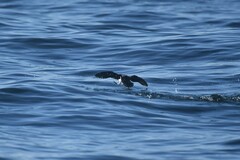
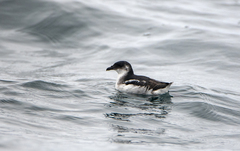
The Peruvian diving petrel (Pelecanoides garnotii) (local name in Peru: potoyunco) is a small seabird that feeds in offshore waters in the Humboldt Current off Peru and Chile. The Peruvian diving petrel was formally described in 1828 by the French naturalists René Lesson and Prosper Garnot under the binomial name Puffinuria garnotti. In his book Manuel d'ornithologie Lesson quotes the text of a description written by Garnot. The Peruvian diving petrel is now placed in the genus Pelecanoides was originally introduced in 1799 by the French naturalist Bernard Germain de Lacépède for the common diving petrel. The species is monotypic: no subspecies are recognised.

Peruvian diving petrel is 20–24 cm (7.9–9.4 in) in overall length. Like the rest of the diving petrels it is a nondescript bird, with a dark back and pale belly, and blue feet, and can be separated from the rest of its family only by differences in its beak and nostrils.

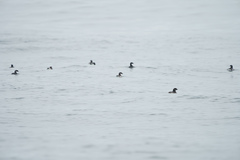
Unlike the common diving petrel and the South Georgia diving petrel it feeds in cold, offshore, often pelagic water, obtaining small fish larvae and planktonic crustaceans by pursuit diving... Wikipedia →

Global Distribution

Parks Where Found

# Park Country Daily sighting probability

More parks will be added in future updates.

Cities Where Found

# City Country Daily sighting probability
1 Lima 🇵🇪 Peru
<5%

Before you go

What are the chances of seeing a Peruvian Diving-Petrel in Lima?

Rare

Under 5% of wildlife watchers report a Peruvian Diving-Petrel sighting in Lima on a given day, based on 24 verified sightings from GBIF citizen-science data. It is the 143rd most-seen of the 171 birds we can rate there. Over three days the chance rises to under 5%, if each day is a fresh chance.

When is the best time to see a Peruvian Diving-Petrel in Lima?

Any time of year

In every month with enough records, under 5% of wildlife watchers report a Peruvian Diving-Petrel in Lima on a given day, so our monthly data shows no clear season.

What time of day is best to see a Peruvian Diving-Petrel?

Between 10 am and 1 pm

Across all the parks we cover, that three-hour window holds the most Peruvian Diving-Petrel sightings with a recorded time, and about 8 in 10 of them come between 6 am and 6 pm: it is a daytime animal.

Where else can you see a Peruvian Diving-Petrel?

Only Lima, in our data

Lima is the only city on Wallace's Line with enough records to rate Peruvian Diving-Petrel sightings: under 5% of wildlife watchers there report one on a given day.

Where does the Peruvian Diving-Petrel sighting chance come from?

GBIF citizen-science records

It is estimated from how often the Peruvian Diving-Petrel is recorded against all the birds logged in Lima (24 verified sightings), calibrated against known sighting rates. Figures are rounded to the nearest 10% because citizen-science data supports honest approximations, not decimals, and months with records from fewer than five people show "—". How it works.

← Back to Lima