Garden Dormouse

Garden Dormouse

Eliomys quercinus

Silhouette: Alexandra van der Geer · PhyloPic

LCNTVUVulnerableENCR
Daily sighting probability <5% · Rare
at Lisbon

In 3 days ~10% in a week ~20%

6 Verified sightings at Lisbon
June Best month
☀️🌙 Day & Night When it's spotted

About the Garden Dormouse

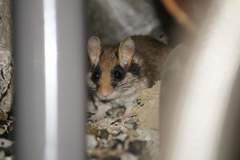
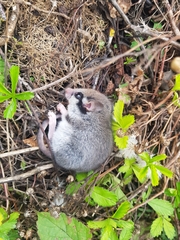
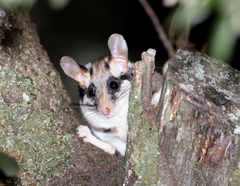
The garden dormouse (Eliomys quercinus) is a species of dormouse native to Europe. The garden dormouse is gray or brown, with a whitish underside. It has black eye markings and large ears. Its hair is short, and its tail has a white tassel at the end. It is typically 10 to 15 cm (3.9 to 5.9 in) in head to body length, with a 8 to 14.5 cm (3.1 to 5.7 in) long tail. It weighs 60 to 140 g (2.1 to 4.9 oz).

In spite of its name, the garden dormouse's main habitat is the forest, though it can also be found in fruit-growing regions. It is particularly common in southern Europe, but its range extends into the north. Garden dormice are often found in the Alps, the Bavarian Forest, and the Ore Mountains.

The species is also present in northern Germany, but that population is apparently not capable of large-scale reproduction. In the Netherlands, it is almost extirpated: in 2007, researchers reported finding only nine animals in two woods in the province of Limburg, where it used to be common. They suggested this is a result of the landscape becoming increasingly monotonous and due to climate change, which they said interrupts hibernation... Wikipedia →

Sounds

Call0:50

France · 2025

© Romain Dupraz · XC1031343 · CC BY-NC-SA 4.0

Call0:24

France · 2022

© Fabien H · XC748054 · CC BY-NC-SA 4.0

Recording0:19

Germany · 2022

© fschrauth · iNaturalist · CC BY-NC 4.0

Global Distribution

Parks Where Found

# Park Country Daily sighting probability

More parks will be added in future updates.

Cities Where Found

# City Country Daily sighting probability
1 Lyon 🇫🇷 France
~10%
2 Lisbon 🇵🇹 Portugal
<5%

Zoos & Centres Where Found

# Zoo / Centre Country
1 Zoo Pilsen 🇨🇿 Czechia In captivity

Before you go

What are the chances of seeing a Garden Dormouse in Lisbon?

Rare

Under 5% of wildlife watchers report a Garden Dormouse sighting in Lisbon on a given day, based on 6 verified sightings from GBIF citizen-science data. It is the 8th most-seen of the 9 mammals we can rate there. Over three days the chance rises to about 10%, and over a week to about 20%, if each day is a fresh chance.

When is the best time to see a Garden Dormouse in Lisbon?

June

In that month about 10% of wildlife watchers report a Garden Dormouse in Lisbon on a given day, against under 5% in July to May, the lowest months. That is one of Lisbon's driest months, with about 15 mm of rain against 95 mm in November.

What time of day is best to see a Garden Dormouse?

Between 9 pm and midnight

Across all the parks we cover, that three-hour window holds the most Garden Dormouse sightings with a recorded time, and about half of them come between 6 am and 6 pm: it is seen both by day and at night.

Is Lisbon the best place to see a Garden Dormouse?

2nd of 2

Of the 2 cities where we can rate Garden Dormouse sightings, Lisbon ranks 2nd at under 5%. The best odds are in Lyon (France, about 10%).

Which relatives of the Garden Dormouse live in Lisbon?

Same order: Rodentia

The closest relatives of the Garden Dormouse that you can see in Lisbon (order Rodentia, Rodents) are Eurasian Red Squirrel (about 20%) and Brown Rat (about 10%), with each one's daily chance of a sighting.

Where does the Garden Dormouse sighting chance come from?

GBIF citizen-science records

It is estimated from how often the Garden Dormouse is recorded against all the mammals logged in Lisbon (6 verified sightings), calibrated against known sighting rates. Figures are rounded to the nearest 10% because citizen-science data supports honest approximations, not decimals, and months with records from fewer than five people show "—". How it works.

← Back to Lisbon