


Completed




Common Hedgehog
Erinaceus europaeus
Silhouette: Steven Traver · PhyloPic
- KingdomAnimalia (Animals)
- PhylumChordata (Chordates)
- ClassMammalia (Mammals)
- OrderErinaceomorpha
- FamilyErinaceidae (Hedgehogs and Gymnures)
- GenusErinaceus (Woodland Hedgehogs)
- SpeciesErinaceus europaeus (Common Hedgehog)
In 3 days ~30% in a week ~60%
104 Verified sightings at Lisbon
212 In all 9 parks From 2019 to 2026
February Best month
🌙 Nocturnal When it's spotted
About the Common Hedgehog
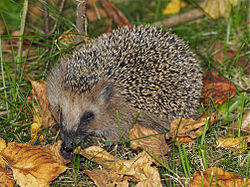
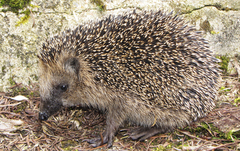
The European hedgehog (Erinaceus europaeus), also known as the West European hedgehog or common hedgehog, is a hedgehog species native to Europe from Iberia and Italy northwards into Scandinavia and westwards into Ireland. It is a generally common and widely distributed species that can survive across a wide range of habitat types. It is a well-known species, and a favourite in European gardens, both for its endearing appearance and its preference for eating a range of garden pests. While populations are currently stable across much of its range, it is declining severely in Great Britain, where it is now Red Listed, meaning that it is considered to be at risk of local extinction. Outside its native range the species was introduced to New Zealand during the late nineteenth and early twentieth centuries.
The European hedgehog has a generalised body structure with unspecialised limb girdles. It appears brownish with most of its body covered by up to 6000 brown and white spines. The length of head and body is ~160 mm (6 in) at weaning, increasing to 260 mm (10 in) or more in large adults. It has an extremely short tail as an almost vestigial feature, typically 20 to... Wikipedia →
Recent sightings of Common Hedgehog in Lisbon
LIVEiNaturalistGlobal Distribution
Parks Where Found
| # | Park | Country | Daily sighting probability |
|---|---|---|---|
| 1 | Bavarian Forest National Park | 🇩🇪 Germany | |
| 2 | Egmont National Park | 🇳🇿 New Zealand | |
| 3 | Wadden Sea National Park | 🇩🇪 Germany | |
| 4 | Snowdonia National Park | 🇬🇧 United Kingdom | |
| 5 | Cévennes National Park | 🇫🇷 France | |
| 6 | Cairngorms National Park | 🇬🇧 United Kingdom | |
| 7 | Pyrénées National Park | 🇫🇷 France | |
| 8 | Fiordland National Park | 🇳🇿 New Zealand | |
| 9 | Sierra de Guadarrama National Park | 🇪🇸 Spain |
Zoos & Centres Where Found
| # | Zoo / Centre | Country | |
|---|---|---|---|
| 1 | Pairi Daiza | 🇧🇪 Belgium | |
| 2 | British Wildlife Centre | 🇬🇧 United Kingdom | |
| 3 | Belgrade Zoo | 🇷🇸 Serbia | |
| 4 | AQUA Akvarium & Dyrepark | 🇩🇰 Denmark | |
| 5 | vzw Opvangcentrum voor Vogels en Wilde dieren | 🇧🇪 Belgium | |
| 6 | Zoológico La Era de las aves | 🇪🇸 Spain |
Closest Relatives at Lisbon
No species of the same family or order lives in Lisbon, so these are its closest relatives here: other mammals.





Before you go
What are the chances of seeing a Common Hedgehog in Lisbon?
With luck
About 10% of wildlife watchers report a Common Hedgehog sighting in Lisbon on a given day, based on 104 verified sightings from GBIF citizen-science data. It is the 2nd most-seen of the 9 mammals we can rate there. Over three days the chance rises to about 30%, and over a week to about 60%, if each day is a fresh chance.
When is the best time to see a Common Hedgehog in Lisbon?
January to March
In those months about 20% of wildlife watchers report a Common Hedgehog in Lisbon on a given day, against about 10% in April to December, the lowest months.
What time of day is best to see a Common Hedgehog?
Between 8 and 11 pm
Across all the parks we cover, that three-hour window holds the most Common Hedgehog sightings with a recorded time, and about 7 in 10 of them come between 6 pm and 6 am: it is mostly seen at night.
Is Lisbon the best place to see a Common Hedgehog?
22nd of 31
Of the 31 cities where we can rate Common Hedgehog sightings, Lisbon ranks 22nd at about 10%. The best odds are in Liverpool (United Kingdom, about 50%), Manchester (United Kingdom, about 30%) and Turin (Italy, about 30%).
Where does the Common Hedgehog sighting chance come from?
GBIF citizen-science records
It is estimated from how often the Common Hedgehog is recorded against all the mammals logged in Lisbon (104 verified sightings), calibrated against known sighting rates. Figures are rounded to the nearest 10% because citizen-science data supports honest approximations, not decimals, and months with records from fewer than five people show "—". How it works.
