Great Crested Newt

Great Crested Newt

Triturus cristatus

Silhouette: Steven Traver · PhyloPic

LCLeast ConcernNTVUENCR
Daily sighting probability ~10% · With luck
at London

In 3 days ~20% in a week ~30%

29 Verified sightings at London
April Best month
☀️🌙 Day & Night When it's spotted

About the Great Crested Newt

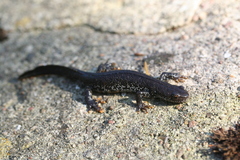
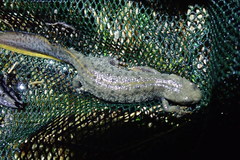
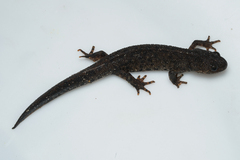
The northern crested newt, great crested newt or warty newt (Triturus cristatus) is a newt species native to Great Britain, northern and central continental Europe and parts of Western Siberia. It is a large newt, with females growing up to 16 cm (6.3 in) long. Its back and sides are dark brown, while the belly is yellow to orange with dark blotches. During the breeding season, males develop a conspicuous jagged crest on their back and tail.

The northern crested newt spends most of the year on land, primarily in wooded areas of the lowlands. In spring, it moves to aquatic breeding sites, mainly larger fish-free ponds. Males court females with a ritualised display and deposit a spermatophore on the ground, which the female then picks up with her cloaca. After fertilisation, a female lays around 200 eggs, folding them into water plants. The larvae develop over two to four months before metamorphosing into terrestrial juveniles (efts). Both larvae and land-dwelling newts mainly feed on different invertebrates.

Several former subspecies of the northern crested newt are now recognised as separate species within the genus Triturus. Its closest relative is the Danube crested newt (T. dobrogicus). It sometimes forms hybrids with some of its relatives, including the marbled newt (T. marmoratus). Although it is currently the most widespread Triturus species, the northern crested newt was probably confined to small refugial areas in the Carpathians during the Last Glacial Maximum.

While the International Union for Conservation of Nature lists the northern crested newt as a species of Least Concern, its populations have been declining. The main threat is habitat destruction, for example, through urban sprawl. The species is also listed as a European Protected Species. Wikipedia →

Global Distribution

Parks Where Found

# Park Country Daily sighting probability

More parks will be added in future updates.

Cities Where Found

# City Country Daily sighting probability
1 Bucharest 🇷🇴 Romania
~10%
2 Copenhagen 🇩🇰 Denmark
~10%
3 London 🇬🇧 United Kingdom
~10%
4 Prague 🇨🇿 Czechia
<5%
5 Moscow 🇷🇺 Russia
<5%

Zoos & Centres Where Found

# Zoo / Centre Country
1 Slimbridge Wetland Centre 🇬🇧 United Kingdom In captivity
2 London Zoo 🇬🇧 United Kingdom In captivity
3 AQUA Akvarium & Dyrepark 🇩🇰 Denmark In captivity
4 Alpenzoo Innsbruck 🇦🇹 Austria In captivity

Before you go

What are the chances of seeing a Great Crested Newt in London?

With luck

About 10% of wildlife watchers report a Great Crested Newt sighting in London on a given day, based on 29 verified sightings from GBIF citizen-science data. It is the 5th most-seen of the 7 amphibians we can rate there. Over three days the chance rises to about 20%, and over a week to about 30%, if each day is a fresh chance.

When is the best time to see a Great Crested Newt in London?

March–May, July–September and November

In those months about 10% of wildlife watchers report a Great Crested Newt in London on a given day, against under 5% in June, October and December–February, the lowest months.

What time of day is best to see a Great Crested Newt?

Between 10 am and 1 pm

Across all the parks we cover, that three-hour window holds the most Great Crested Newt sightings with a recorded time, and about 6 in 10 of them come between 6 am and 6 pm: it is seen both by day and at night.

Is London the best place to see a Great Crested Newt?

Among the best

Of the 5 cities where we can rate Great Crested Newt sightings, London ranks 3rd at about 10%, level with the leaders once rounded. The best odds are in Bucharest (Romania, about 10%) and Copenhagen (Denmark, about 10%).

Which relatives of the Great Crested Newt live in London?

Same family: Salamandridae

The closest relatives of the Great Crested Newt that you can see in London (family Salamandridae, True Salamanders and Newts) are Smooth Newt (about 30%) and Palmate Newt (about 10%), with each one's daily chance of a sighting.

Where does the Great Crested Newt sighting chance come from?

GBIF citizen-science records

It is estimated from how often the Great Crested Newt is recorded against all the amphibians logged in London (29 verified sightings), calibrated against known sighting rates. Figures are rounded to the nearest 10% because citizen-science data supports honest approximations, not decimals, and months with records from fewer than five people show "—". How it works.

← Back to London