Black Turnstone

Black Turnstone

Arenaria melanocephala

Silhouette: Elaine R. Wilson (modified) · PhyloPic

LCLeast ConcernNTVUENCR
Daily sighting probability <5% · Rare
at Los Angeles

In 3 days <5% in a week ~10%

1,416 Verified sightings at Los Angeles
2,801 In all 7 parks From 2019 to 2026
January Best month
☀️ Diurnal When it's spotted

About the Black Turnstone

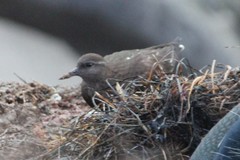
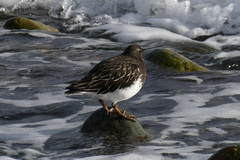
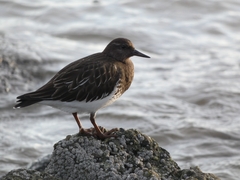
The black turnstone (Arenaria melanocephala) is a species of small wading bird. It is one of two species of turnstone in the genus Arenaria, the ruddy turnstone (A. interpres) being the other. It is now classified in the sandpiper family, Scolopacidae, but was formerly sometimes placed in the plover family, Charadriidae. It is native to the west coast of North America and breeds only in Alaska.

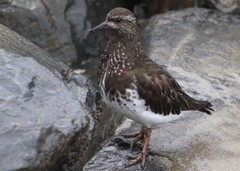
It is 22–25 centimeters (8.7–9.8 in) long and weighs 100–170 grams (3.5–6.0 oz). The black bill is 20–27 millimeters (0.8–1.1 in) long and slightly upturned. The legs and feet are blackish-brown with a reddish tinge. The bird is largely black and white in appearance. Breeding-plumaged adults have a black head and breast apart from a white spot between the eye and bill, a white stripe over the eye and white flecks on the sides of the breast. The upper parts are blackish-brown with pale fringes to the wing-coverts and scapular feathers. The belly and vent are white. In flight it shows a white wingbar, white shoulder patch and white tail with a broad black band across it. There is white from the lower back to the upper tail-coverts apart from a dark bar across the rump.

In winter... Wikipedia →

Sounds

Call0:11

United States · 2022

© Anthony Gliozzo · XC698319 · CC BY-NC-SA 4.0

Flight call0:21

United States · 2012

© Paul Marvin · XC160970 · CC BY-NC-SA 3.0

Alarm call0:12

United States · 2020

© Steve Hampton · XC583934 · CC BY-NC-SA 4.0

Global Distribution

Parks Where Found

# Park Country Daily sighting probability
1 Channel Islands National Park 🇺🇸 United States
~20%
2 Great Bear Rainforest 🇨🇦 Canada
~10%
3 Pacific Rim National Park Reserve 🇨🇦 Canada
~10%
4 Katmai National Park 🇺🇸 United States
~10%
5 Redwood National Park 🇺🇸 United States
<5%
6 El Vizcaíno Biosphere Reserve 🇲🇽 Mexico
<5%
7 Olympic National Park 🇺🇸 United States
<5%

Cities Where Found

# City Country Daily sighting probability
1 San Diego 🇺🇸 United States
~10%
2 San Francisco 🇺🇸 United States
<5%
3 Anchorage 🇺🇸 United States
<5%
4 Seattle 🇺🇸 United States
<5%
5 Los Angeles 🇺🇸 United States
<5%
6 Vancouver 🇨🇦 Canada
<5%

Zoos & Centres Where Found

# Zoo / Centre Country
1 Monterey Bay Aquarium 🇺🇸 United States In captivity

Before you go

What are the chances of seeing a Black Turnstone in Los Angeles?

Rare

Under 5% of wildlife watchers report a Black Turnstone sighting in Los Angeles on a given day, based on 1,416 verified sightings from GBIF citizen-science data. It is the 214th most-seen of the 426 birds we can rate there. Over three days the chance rises to under 5%, and over a week to about 10%, if each day is a fresh chance.

When is the best time to see a Black Turnstone in Los Angeles?

Any time of year

In every month with enough records, under 5% of wildlife watchers report a Black Turnstone in Los Angeles on a given day, so our monthly data shows no clear season.

What time of day is best to see a Black Turnstone?

Between 11 am and 2 pm

Across all the parks we cover, that three-hour window holds the most Black Turnstone sightings with a recorded time, and about 9 in 10 of them come between 6 am and 6 pm: it is a daytime animal.

Is Los Angeles the best place to see a Black Turnstone?

5th of 6

Of the 6 cities where we can rate Black Turnstone sightings, Los Angeles ranks 5th at under 5%. The best odds are in San Diego (United States, about 10%), San Francisco (United States, under 5%) and Anchorage (United States, under 5%).

Where does the Black Turnstone sighting chance come from?

GBIF citizen-science records

It is estimated from how often the Black Turnstone is recorded against all the birds logged in Los Angeles (1,416 verified sightings), calibrated against known sighting rates. Figures are rounded to the nearest 10% because citizen-science data supports honest approximations, not decimals, and months with records from fewer than five people show "—". How it works.

← Back to Los Angeles