Cassin's Auklet

Cassin's Auklet

Ptychoramphus aleuticus

Silhouette: Sheatherius · PhyloPic

LCNTNear ThreatenedVUENCR
Daily sighting probability <5% · Rare
at Los Angeles

In 3 days <5%

7 Verified sightings at Los Angeles
551 In all 4 parks From 2019 to 2026
January Best month
☀️ Diurnal When it's spotted

About the Cassin's Auklet

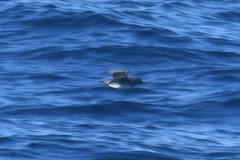
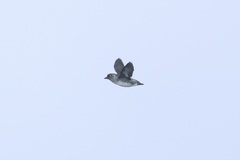
Cassin's auklet (Ptychoramphus aleuticus) is a small, chunky seabird that ranges widely in the North Pacific. It is the only species placed in the genus Ptychoramphus. It nests in small burrows and because of its presence on well studied islands in British Columbia and off California it is one of the better known auks. It is named for the American ornithologist John Cassin.

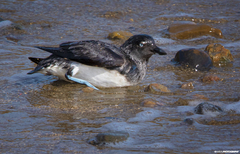
Cassin's auklet is a small (25 cm, 200 g) nondescript auk. Its plumage is generally dark above and pale below, with a small white mark above the eye. Its bill is overall dark with a pale spot, and its feet are blue. Unlike many other auks, Cassin's auklet lacks dramatic breeding plumage, remaining the same over most of the year. At sea it is usually identified by its flight, which is described as looking like a flying tennis ball.

Cassin's auklet ranges from midway up the Baja California peninsula to Alaska's Aleutian Islands, off North America. It nests on offshore islands, with the main population stronghold being Triangle Island off Vancouver Island's Cape Scott, where the population is estimated to be around 55,0000 pairs. It is not known to be migratory. However, northern birds may move farther south during the winter.

Two subspecies are recognised: An extinct relative or predecessor species, Ptychoramphus tenuis L. H. Miller et Bowman, 1958, is known from the Late Pliocene of the San Diego Formation in California. Wikipedia →

Sounds

Song0:41

United States · 2023

© Matthew L. Brady · XC842473 · CC BY-NC-SA 4.0

Recording0:32

Mexico · 2022

© Álvaro San José Elizundia · iNaturalist · CC BY-NC 4.0

Global Distribution

Parks Where Found

# Park Country Daily sighting probability
1 Great Bear Rainforest 🇨🇦 Canada
<5%
2 Channel Islands National Park 🇺🇸 United States
<5%
3 Olympic National Park 🇺🇸 United States
<5%
4 Pacific Rim National Park Reserve 🇨🇦 Canada
<5%

Cities Where Found

# City Country Daily sighting probability
1 San Diego 🇺🇸 United States
<5%
2 Seattle 🇺🇸 United States
<5%
3 Los Angeles 🇺🇸 United States
<5%

Before you go

What are the chances of seeing a Cassin's Auklet in Los Angeles?

Rare

Under 5% of wildlife watchers report a Cassin's Auklet sighting in Los Angeles on a given day, based on 7 verified sightings from GBIF citizen-science data. It is the 408th most-seen of the 426 birds we can rate there. Over three days the chance rises to under 5%, if each day is a fresh chance.

When is the best time to see a Cassin's Auklet in Los Angeles?

Any time of year

In every month with enough records, under 5% of wildlife watchers report a Cassin's Auklet in Los Angeles on a given day, so our monthly data shows no clear season.

What time of day is best to see a Cassin's Auklet?

Between 10 am and 1 pm

Across all the parks we cover, that three-hour window holds the most Cassin's Auklet sightings with a recorded time, and about 9 in 10 of them come between 6 am and 6 pm: it is a daytime animal.

Is Los Angeles the best place to see a Cassin's Auklet?

Among the best

Of the 3 cities where we can rate Cassin's Auklet sightings, Los Angeles ranks 3rd at under 5%, level with the leaders once rounded. The best odds are in San Diego (United States, under 5%) and Seattle (United States, under 5%).

Where does the Cassin's Auklet sighting chance come from?

GBIF citizen-science records

It is estimated from how often the Cassin's Auklet is recorded against all the birds logged in Los Angeles (7 verified sightings), calibrated against known sighting rates. Figures are rounded to the nearest 10% because citizen-science data supports honest approximations, not decimals, and months with records from fewer than five people show "—". How it works.

← Back to Los Angeles