Rufous-tailed Palm-Thrush

Rufous-tailed Palm-Thrush

Cichladusa ruficauda

LCLeast ConcernNTVUENCR
Daily sighting probability ~20% · Possible
at Luanda

In 3 days ~60% in a week ~90%

40 Verified sightings at Luanda
April Best month
☀️ Diurnal When it's spotted

About the Rufous-tailed Palm-Thrush

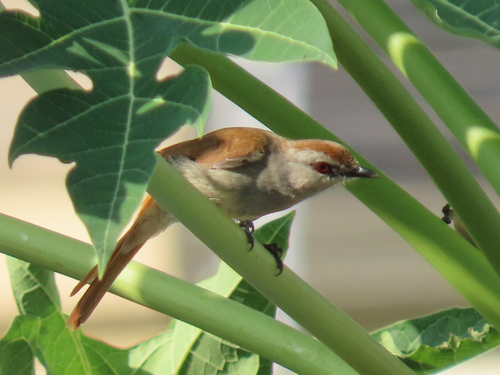
The rufous-tailed palm thrush (Cichladusa ruficauda) is a species of bird in the family Muscicapidae. The rufous-tailed palm thrush was described as Bradyornis ruficauda by Hartlaub in 1857. The species is monotypic. This species is found in Angola, Central African Republic, Republic of the Congo, Democratic Republic of the Congo, Equatorial Guinea, Gabon, and Namibia. The size of its range is estimated at 1,700,000 km2 (660,000 sq mi). Its habitat is palms, dry forests and secondary forests in riparian and coastal areas, at elevations of up to 1,200 m (3,900 ft). It also occurs in banana plantations and gardens.

Its length is 17–18 cm (6.7–7.1 in), and its weight is 22–37 g (0.78–1.31 oz). The sexes are alike. The head and nape are bright rufous-brown. The back, scapulars and the median and greater coverts are also rufous-brown but are slightly paler. The flight feathers are dark brown, with rufous or rufous-brown edges, and the underwing coverts are pale buffish-brown. The rump and tail are rufous-brown or chestnut. The face and neck-sides are mostly pale grey, with the lores being darker. The chin, throat and upper breast... Wikipedia →
Global Distribution

Parks Where Found

# Park Country Daily sighting probability

More parks will be added in future updates.

Cities Where Found

# City Country Daily sighting probability
1 Brazzaville 🇨🇬 Republic of the Congo
~80%
2 Luanda 🇦🇴 Angola
~20%

Before you go

What are the chances of seeing a Rufous-tailed Palm-Thrush in Luanda?

Possible

About 20% of wildlife watchers report a Rufous-tailed Palm-Thrush sighting in Luanda on a given day, based on 40 verified sightings from GBIF citizen-science data. It is the 13th most-seen of the 45 birds we can rate there. Over three days the chance rises to about 60%, and over a week to about 90%, if each day is a fresh chance.

When is the best time to see a Rufous-tailed Palm-Thrush in Luanda?

April

In that month about 40% of wildlife watchers report a Rufous-tailed Palm-Thrush in Luanda on a given day, against about 10% in September, the lowest month. That is one of Luanda's wettest months, with about 80 mm of rain against almost none in July. February–March, June and December have too few records to rate.

What time of day is best to see a Rufous-tailed Palm-Thrush?

Between 8 and 11 am

Across all the parks we cover, that three-hour window holds the most Rufous-tailed Palm-Thrush sightings with a recorded time, and about 8 in 10 of them come between 6 am and 6 pm: it is a daytime animal.

Is Luanda the best place to see a Rufous-tailed Palm-Thrush?

2nd of 2

Of the 2 cities where we can rate Rufous-tailed Palm-Thrush sightings, Luanda ranks 2nd at about 20%. The best odds are in Brazzaville (Republic of the Congo, about 80%).

Which relatives of the Rufous-tailed Palm-Thrush live in Luanda?

Same order: Passeriformes

The closest relatives of the Rufous-tailed Palm-Thrush that you can see in Luanda (order Passeriformes, Perching Birds) are Pied Crow (about 50%), House Sparrow (about 40%) and Common Bulbul (about 40%), with each one's daily chance of a sighting.

Where does the Rufous-tailed Palm-Thrush sighting chance come from?

GBIF citizen-science records

It is estimated from how often the Rufous-tailed Palm-Thrush is recorded against all the birds logged in Luanda (40 verified sightings), calibrated against known sighting rates. Figures are rounded to the nearest 10% because citizen-science data supports honest approximations, not decimals, and months with records from fewer than five people show "—". How it works.

← Back to Luanda
