


Bruce's Green-Pigeon

Bruce's Green-Pigeon

Treron waalia

Silhouette: Sheatherius · PhyloPic

LCLeast ConcernNTVUENCR
Daily sighting probability ~10% · With luck
at Maiduguri

In 3 days ~20% in a week ~40%

10 Verified sightings at Maiduguri
307 In all 5 parks From 2019 to 2026
April Best month
☀️ Diurnal When it's spotted

About the Bruce's Green-Pigeon

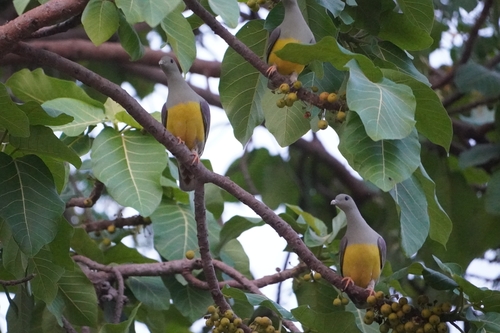
Bruce's green pigeon (Treron waalia), also known as the yellow-bellied fruit pigeon or the yellow-bellied green pigeon, is a species of bird in the family Columbidae. Its range extends across the Sudan (region) towards the Red Sea and the Southwestern Arabian foothills savanna and Dhofar Mountains.

It is a frugivore bird species that specialises on eating the fruits of a single species of fig tree, Ficus platyphylla. Unlike most birds, it does not have a uropygial gland. Despite its name, Bruce's green pigeon is mostly grey with a light yellow breast and olive green upper wings.

Wikipedia →

Sounds

Call0:21

Oman · 2014

© Matthias Feuersenger · XC371214 · CC BY-NC-SA 4.0

Song0:38

Ethiopia · 2015

© Hans Matheve · XC305857 · CC BY-NC-ND 4.0

Song0:08

Oman · 2026

© Tomasz Kułakowski · XC1078170 · CC BY-NC-SA 4.0

Global Distribution

Parks Where Found

# Park Country Daily sighting probability
1 Mole National Park 🇬🇭 Ghana
~40%
2 Kidepo Valley National Park 🇺🇬 Uganda
~30%
3 Niokolo-Koba National Park 🇸🇳 Senegal
~10%
4 Awash National Park 🇪🇹 Ethiopia
<5%
5 Murchison Falls National Park 🇺🇬 Uganda
<5%

Cities Where Found

# City Country Daily sighting probability
1 Maiduguri 🇳🇬 Nigeria
~10%

Zoos & Centres Where Found

# Zoo / Centre Country
1 Disney's Animal Kingdom 🇺🇸 United States In captivity
2 San Diego Zoo 🇺🇸 United States In captivity
3 Bronx Zoo 🇺🇸 United States In captivity
4 Sedgwick County Zoo 🇺🇸 United States In captivity
5 Wilhelma 🇩🇪 Germany In captivity
6 San Antonio Zoo 🇺🇸 United States In captivity
7 Riverbanks Zoo 🇺🇸 United States In captivity
8 Vogelpark Avifauna 🇳🇱 Netherlands In captivity
9 Central Park Zoo 🇺🇸 United States In captivity
10 Palo Alto Junior Museum and Zoo 🇺🇸 United States In captivity

Before you go

What are the chances of seeing a Bruce's Green-Pigeon in Maiduguri?

With luck

About 10% of wildlife watchers report a Bruce's Green-Pigeon sighting in Maiduguri on a given day, based on 10 verified sightings from GBIF citizen-science data. It is the 50th most-seen of the 65 birds we can rate there. Over three days the chance rises to about 20%, and over a week to about 40%, if each day is a fresh chance.

When is the best time to see a Bruce's Green-Pigeon in Maiduguri?

April

In that month about 20% of wildlife watchers report a Bruce's Green-Pigeon in Maiduguri on a given day, against under 5% in February, August–September and December, the lowest months. That is one of Maiduguri's driest months, with about 5 mm of rain against 180 mm in August. November has too few records to rate.

What time of day is best to see a Bruce's Green-Pigeon?

Between 7 and 10 am

Across all the parks we cover, that three-hour window holds the most Bruce's Green-Pigeon sightings with a recorded time, and about 8 in 10 of them come between 6 am and 6 pm: it is a daytime animal.

Where else can you see a Bruce's Green-Pigeon?

Only Maiduguri, in our data

Maiduguri is the only city on Wallace's Line with enough records to rate Bruce's Green-Pigeon sightings: about 10% of wildlife watchers there report one on a given day.

Which relatives of the Bruce's Green-Pigeon live in Maiduguri?

Same family: Columbidae

The closest relatives of the Bruce's Green-Pigeon that you can see in Maiduguri (family Columbidae, Pigeons and Doves) are Laughing Dove (about 90%), Speckled Pigeon (about 80%) and African Mourning Dove (about 70%), with each one's daily chance of a sighting.

Where does the Bruce's Green-Pigeon sighting chance come from?

GBIF citizen-science records

It is estimated from how often the Bruce's Green-Pigeon is recorded against all the birds logged in Maiduguri (10 verified sightings), calibrated against known sighting rates. Figures are rounded to the nearest 10% because citizen-science data supports honest approximations, not decimals, and months with records from fewer than five people show "—". How it works.

← Back to Maiduguri