Australasian Bittern

Australasian Bittern

Botaurus poiciloptilus

Silhouette: Sheatherius · PhyloPic

LCNTVUVulnerableENCR
Daily sighting probability <5% · Rare
at Melbourne

In 3 days <5%

9 Verified sightings at Melbourne
February Best month
☀️ Diurnal When it's spotted

About the Australasian Bittern

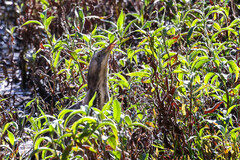
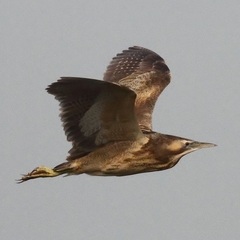
The Australasian bittern (Botaurus poiciloptilus), or Matuku-hūrepo in Māori, is a stocky, sizeable and elusive heron-like bird native to the wetlands of Australia, New Zealand, and New Caledonia. It belongs to the bittern subfamily of the heron family Ardeidae. The Australasian bittern is best known for its cryptic plumage and behaviours, which allows it to blend into the rushes and reeds of its wetland habitats, making it particularly difficult to spot. Despite being rarely seen, Australasian bittern males have a distinct "booming" call that can carry long distances. This call is said to resemble that of a Bunyip, which is why the Australasian bittern is often known as "the Bunyip Bird" in parts of Australia.

Physically, the Australasian bittern stands around 66-76 cm tall with a wingspan of around a metre long. Its streaky, beige, mottled plumage allows it to camouflage itself among the reeds and rushes of its habitat to avoid predators and hunt for prey, undetected. The species primarily feeds on fish, amphibians, and invertebrates, which it hunts by quietly stalking through shallow waters or remaining "frozen" before ambushing its prey.

Historically, the Australasian bittern was described in the early 19th century and has since been of significant interest due to its cryptic nature. The species is classified as Vulnerable on the IUCN Red List, and continues to experience population declines resulting from habitat reduction and disturbance from wetland drainage, climate change and agricultural expansion. Conservation efforts are therefore becoming increasingly necessary for its survival.

Researchers continue to attempt to understand this birds' daily patterns, ecology, and breeding behaviour to improve current conservation strategies, although their cryptic nature makes this particularly difficult. Wikipedia →

Sounds

Recording1:00

Australia · 2025

© bkcw8 · iNaturalist · CC BY-NC 4.0

Recording0:08

New Zealand · 2022

© greghadley1 · iNaturalist · CC BY-NC 4.0

Recording0:32

New Zealand · 2025

© Ben Ackerley · iNaturalist · CC BY-NC 4.0

Global Distribution

Parks Where Found

# Park Country Daily sighting probability

More parks will be added in future updates.

Cities Where Found

# City Country Daily sighting probability
1 Brisbane 🇦🇺 Australia
<5%
2 Melbourne 🇦🇺 Australia
<5%

Zoos & Centres Where Found

# Zoo / Centre Country
1 Hamilton Zoo 🇳🇿 New Zealand In captivity

Before you go

What are the chances of seeing an Australasian Bittern in Melbourne?

Rare

Under 5% of wildlife watchers report an Australasian Bittern sighting in Melbourne on a given day, based on 9 verified sightings from GBIF citizen-science data. It is the 221st most-seen of the 236 birds we can rate there. Over three days the chance rises to under 5%, if each day is a fresh chance.

When is the best time to see an Australasian Bittern in Melbourne?

Any time of year

In every month with enough records, under 5% of wildlife watchers report an Australasian Bittern in Melbourne on a given day, so our monthly data shows no clear season.

What time of day is best to see an Australasian Bittern?

Between 10 am and 1 pm

Across all the parks we cover, that three-hour window holds the most Australasian Bittern sightings with a recorded time, and about 8 in 10 of them come between 6 am and 6 pm: it is a daytime animal.

Is Melbourne the best place to see an Australasian Bittern?

Among the best

Of the 2 cities where we can rate Australasian Bittern sightings, Melbourne ranks 2nd at under 5%, level with the leaders once rounded. The best odds are in Brisbane (Australia, under 5%).

Which relatives of the Australasian Bittern live in Melbourne?

Same family: Ardeidae

The closest relatives of the Australasian Bittern that you can see in Melbourne (family Ardeidae, Herons, Egrets, and Bitterns) are White-faced Heron (about 30%), Great Egret (about 10%) and Ardea modesta (about 10%), with each one's daily chance of a sighting.

Where does the Australasian Bittern sighting chance come from?

GBIF citizen-science records

It is estimated from how often the Australasian Bittern is recorded against all the birds logged in Melbourne (9 verified sightings), calibrated against known sighting rates. Figures are rounded to the nearest 10% because citizen-science data supports honest approximations, not decimals, and months with records from fewer than five people show "—". How it works.

← Back to Melbourne