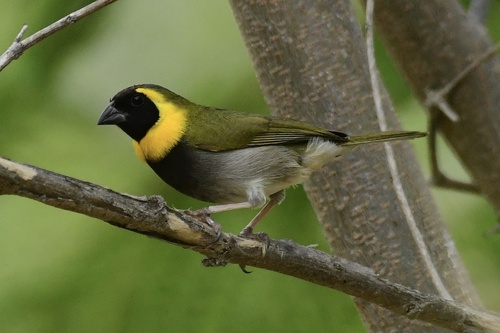
Cuban Grassquit

Cuban Grassquit

Phonipara canora

Silhouette: Sheatherius · PhyloPic

LCLeast ConcernNTVUENCR
Daily sighting probability <5% · Rare
at Miami

In 3 days ~10% in a week ~20%

5 Verified sightings at Miami
19 In 1 park From 2019 to 2026
September Best month
☀️ Diurnal When it's spotted

About the Cuban Grassquit

The Cuban grassquit (Phonipara canora) is a species of bird in the family Thraupidae, the tanagers and allies. It is endemic to Cuba. An introduced population is established on New Providence in the Bahamas. The Cuban grassquit was formally described in 1789 by the German naturalist Johann Friedrich Gmelin under the binomial name Loxia canora. He based his description on the "Brown Cheeked Grosbeak" that had been described by Peter Brown in 1776. Brown's illustration was from a live bird belonging to Marmaduke Tunstall which Brown mistakenly believed had come from Mexico. It only occurs in Cuba. By 1970 the species had been placed in the genus Tiaris, but a molecular phylogenetic study published in 2014 found that Tiaris was polyphyletic. Between 2016 and 2020 taxonomic systems moved the Cuban grassquit to the resurrected genus Phonipara that had been introduced in 1850 by the French naturalist Charles Lucien Bonaparte. The genus name combines the Ancient Greek phōnēs meaning "vocal" with the Latin parus meaning "tit". The specific epithet conora is from Latin canorus meaning "melodious".

Although traditionally placed with the buntings and New World sparrows... Wikipedia →

Sounds

Call0:13

Cuba · 2025

© FREDERIC Lionel · XC994765 · CC BY-NC-SA 4.0

Song0:33

Cuba · 2015

© Hans Matheve · XC256751 · CC BY-NC-ND 4.0

Recording0:07

Bahamas · 2023

© David Chernack · iNaturalist · CC BY-NC 4.0

Global Distribution

Parks Where Found

# Park Country Daily sighting probability
1 Ciénaga de Zapata 🇨🇺 Cuba
<5%

More parks will be added in future updates.

Cities Where Found

# City Country Daily sighting probability
1 Miami 🇺🇸 United States
<5%
2 Havana 🇨🇺 Cuba
<5%

Zoos & Centres Where Found

# Zoo / Centre Country
1 Basel Zoo 🇨🇭 Switzerland In captivity
2 Copenhagen Zoo 🇩🇰 Denmark In captivity
3 The Blue Planet 🇩🇰 Denmark In captivity
4 Zoo Miami 🇺🇸 United States In captivity
5 San Diego Zoo Safari Park 🇺🇸 United States In captivity
6 Wilhelma 🇩🇪 Germany In captivity
7 Schönbrunn Zoo 🇦🇹 Austria In captivity
8 Budapest Zoo & Botanical Garden 🇭🇺 Hungary In captivity
9 Frankfurt Zoological Garden 🇩🇪 Germany In captivity
10 Biotropica 🇫🇷 France In captivity
11 Newquay Zoo 🇬🇧 United Kingdom In captivity
12 National Aviary 🇺🇸 United States In captivity

Before you go

What are the chances of seeing a Cuban Grassquit in Miami?

Rare

Under 5% of wildlife watchers report a Cuban Grassquit sighting in Miami on a given day, based on 5 verified sightings from GBIF citizen-science data. It is the 140th most-seen of the 325 birds we can rate there. Over three days the chance rises to about 10%, and over a week to about 20%, if each day is a fresh chance.

When is the best time to see a Cuban Grassquit in Miami?

Any time of year

In every month with enough records, under 5% of wildlife watchers report a Cuban Grassquit in Miami on a given day, so our monthly data shows no clear season.

What time of day is best to see a Cuban Grassquit?

Between 9 am and noon

Across all the parks we cover, that three-hour window holds the most Cuban Grassquit sightings with a recorded time, and about 9 in 10 of them come between 6 am and 6 pm: it is a daytime animal.

Is Miami the best place to see a Cuban Grassquit?

Yes

Of the 2 cities where we can rate Cuban Grassquit sightings, Miami has the highest daily chance: under 5%. Next come Havana (Cuba, under 5%).

Where does the Cuban Grassquit sighting chance come from?

GBIF citizen-science records

It is estimated from how often the Cuban Grassquit is recorded against all the birds logged in Miami (5 verified sightings), calibrated against known sighting rates. Figures are rounded to the nearest 10% because citizen-science data supports honest approximations, not decimals, and months with records from fewer than five people show "—". How it works.
← Back to Miami