Eastern Toe-Biter

Eastern Toe-Biter

Benacus griseus

Daily sighting probability <5% · Rare
at Miami

In 3 days ~10% in a week ~20%

21 Verified sightings at Miami
42 In all 2 parks From 2019 to 2026
September Best month
🌙 Nocturnal When it's spotted

About the Eastern Toe-Biter

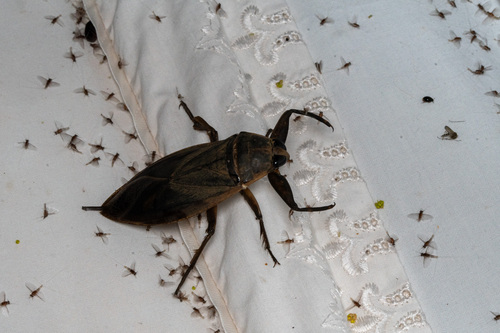
Benacus griseus is a species of giant water bug in the family Belostomatidae. It is the only species in the genus Benacus, which was formerly considered a subgenus of Lethocerus. Benacus griseus is found throughout eastern North America, from New England, west through southern Ontario and to Nebraska, south to Florida and Texas, along the Gulf of Mexico coast in Mexico, and into Cuba.

Adults reach lengths of 47–64 mm, making them one of the largest aquatic insect species found in eastern North America. It is distinguished from other Lethocerinae species by the lack of a groove on its front femur. It is also characterized by a wide hind tibia and black ventral stripes. Wikipedia →

Global Distribution

Parks Where Found

# Park Country Daily sighting probability
1 Big Cypress National Preserve 🇺🇸 United States
~20%
2 Everglades National Park 🇺🇸 United States
~10%

Cities Where Found

# City Country Daily sighting probability
1 Orlando 🇺🇸 United States
<5%
2 Miami 🇺🇸 United States
<5%
3 Houston 🇺🇸 United States
<5%
4 Washington 🇺🇸 United States
<5%

Before you go

What are the chances of seeing an Eastern Toe-Biter in Miami?

Rare

Under 5% of wildlife watchers report an Eastern Toe-Biter sighting in Miami on a given day, based on 21 verified sightings from GBIF citizen-science data. It is the 356th most-seen of the 826 insects we can rate there. Over three days the chance rises to about 10%, and over a week to about 20%, if each day is a fresh chance.

When is the best time to see an Eastern Toe-Biter in Miami?

September

In that month about 10% of wildlife watchers report an Eastern Toe-Biter in Miami on a given day, against under 5% in October to August, the lowest months. That is one of Miami's wettest months, with about 190 mm of rain against 45 mm in January.

What time of day is best to see an Eastern Toe-Biter?

Between 8 and 11 pm

Across all the parks we cover, that three-hour window holds the most Eastern Toe-Biter sightings with a recorded time, and about 8 in 10 of them come between 6 pm and 6 am: it is mostly seen at night.

Is Miami the best place to see an Eastern Toe-Biter?

Among the best

Of the 4 cities where we can rate Eastern Toe-Biter sightings, Miami ranks 2nd at under 5%, level with the leaders once rounded. The best odds are in Orlando (United States, under 5%).

Where does the Eastern Toe-Biter sighting chance come from?

GBIF citizen-science records

It is estimated from how often the Eastern Toe-Biter is recorded against all the insects logged in Miami (21 verified sightings), calibrated against known sighting rates. Figures are rounded to the nearest 10% because citizen-science data supports honest approximations, not decimals, and months with records from fewer than five people show "—". How it works.

← Back to Miami