Scarletsnake

Scarletsnake

Cemophora coccinea

Silhouette: Alex Slavenko · PhyloPic

LCLeast ConcernNTVUENCR Endemic
Daily sighting probability <5% · Rare
at Miami

In 3 days ~10% in a week ~30%

49 Verified sightings at Miami
401 In all 3 parks From 2019 to 2026
June Best month
☀️🌙 Day & Night When it's spotted

About the Scarletsnake

Cemophora coccinea, commonly known as the scarlet snake, is a species of nonvenomous snake in the subfamily Colubrinae of the family Colubridae. The species is native to the southeastern United States. There are two subspecies of C. coccinea that are recognized as being valid. The Texas scarlet snake (C. lineri) was previously considered a subspecies.

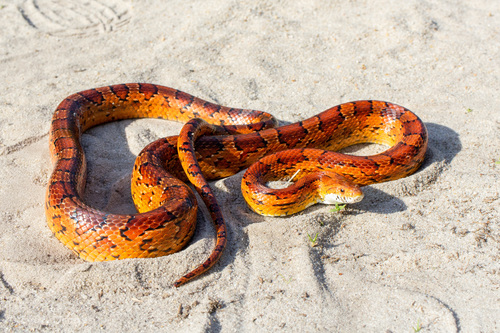
The scarlet snake is relatively small, semi fossorial habitat specialists from southeastern United States, growing to a total length (tail included) of 14–26 inches (36–66 cm) at adult size. The dorsal pattern consists of a light gray ground color, with a series of black-bordered red, white or yellow blotches down the back. The belly is either a uniform light gray or white color. The dorsal blotches can extend down the sides of the body, appearing somewhat like banding or rings, which sometimes leads to confusion with other sympatric species such as the venomous coral snakes or the harmless scarlet king snake. The similar pattern exhibited by these three snakes is a form of mimicry known as batesian mimicry. This is a phenomenon in which members of a palatable species gain protection from predation by resembling or mimicking... Wikipedia →

Global Distribution

Parks Where Found

# Park Country Daily sighting probability
1 Big Cypress National Preserve 🇺🇸 United States
~40%
2 Everglades National Park 🇺🇸 United States
~30%
3 Merritt Island National Wildlife Refuge 🇺🇸 United States
~10%

Cities Where Found

# City Country Daily sighting probability
1 Miami 🇺🇸 United States
<5%
2 Orlando 🇺🇸 United States
<5%

Before you go

What are the chances of seeing a Scarletsnake in Miami?

Rare

Under 5% of wildlife watchers report a Scarletsnake sighting in Miami on a given day, based on 49 verified sightings from GBIF citizen-science data. It is the 32nd most-seen of the 58 reptiles we can rate there. Over three days the chance rises to about 10%, and over a week to about 30%, if each day is a fresh chance.

When is the best time to see a Scarletsnake in Miami?

April to August

In those months about 10% of wildlife watchers report a Scarletsnake in Miami on a given day, against under 5% in September to March, the lowest months.

What time of day is best to see a Scarletsnake?

Between 8 and 11 pm

Across all the parks we cover, that three-hour window holds the most Scarletsnake sightings with a recorded time, and about 7 in 10 of them come between 6 pm and 6 am: it is seen both by day and at night.

Is Miami the best place to see a Scarletsnake?

Yes

Of the 2 cities where we can rate Scarletsnake sightings, Miami has the highest daily chance: under 5%. Next come Orlando (United States, under 5%).

Which relatives of the Scarletsnake live in Miami?

Same family: Colubridae

The closest relatives of the Scarletsnake that you can see in Miami (family Colubridae, Colubrid Snakes) are North American Racer (about 20%), Ringneck Snake (about 10%) and Brown Watersnake (about 10%), with each one's daily chance of a sighting.

Where does the Scarletsnake sighting chance come from?

GBIF citizen-science records

It is estimated from how often the Scarletsnake is recorded against all the reptiles logged in Miami (49 verified sightings), calibrated against known sighting rates. Figures are rounded to the nearest 10% because citizen-science data supports honest approximations, not decimals, and months with records from fewer than five people show "—". How it works.

← Back to Miami