White-throated Blue Swallow

White-throated Blue Swallow

Hirundo nigrita

Silhouette: Matt Wilkins · PhyloPic

LCLeast ConcernNTVUENCR
Daily sighting probability <5% · Rare
at Monrovia

In 3 days ~10% in a week ~20%

6 Verified sightings at Monrovia
12 In 1 park From 2019 to 2026
September Best month
☀️ Diurnal When it's spotted

About the White-throated Blue Swallow

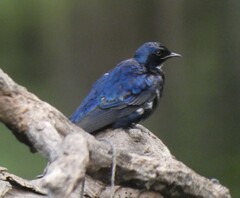
The white-bibbed swallow (Hirundo nigrita), also known as the white-throated blue swallow, is a species of bird in the family Hirundinidae. The plumage is mainly glossy dark blue, but may appear black at a distance. It is widespread but generally uncommon across the African tropical rainforest (including Dahomey Gap). It is generally a resident, non-migratory bird, though it may undertake minor local movements. In Sierra Leone they are noted mainly from December to July, though long-distance seasonal migrations are not suspected. They are found year-round near tropical rivers, lakes, and rainforest streams. No subspecies are known.

They have solitary and territorial nesting habits. The open cup-shaped nests are built by both sexes, and placed from near the water surface to 3 meters up. The nest of mud pellets and some dry grass is lined on the inside with soft material, like feathers, bark strips or grass. Nests are placed on either natural sites like rock faces, cliffs, fallen trees, etc., or less often attached to man-made structures like bridges, piers, etc. The clutch consists of 2 to 3 eggs, and is incubated by the female. The eggs are white and speckled brown and greyish brown. Nestlings leave the nest in 17 to 18 days, but remain in the nest vicinity for some time longer. Wikipedia →

Sounds

Call0:31

Ivory Coast · 2015

© Étienne Leroy · XC217112 · CC BY-NC-SA 4.0

Global Distribution

Parks Where Found

# Park Country Daily sighting probability
1 Taï National Park 🇨🇮 Ivory Coast
~20%

More parks will be added in future updates.

Cities Where Found

# City Country Daily sighting probability
1 Monrovia 🇱🇷 Liberia
<5%

Before you go

What are the chances of seeing a White-throated Blue Swallow in Monrovia?

Rare

Under 5% of wildlife watchers report a White-throated Blue Swallow sighting in Monrovia on a given day, based on 6 verified sightings from GBIF citizen-science data. It is the 43rd most-seen of the 59 birds we can rate there. Over three days the chance rises to about 10%, and over a week to about 20%, if each day is a fresh chance.

When is the best time to see a White-throated Blue Swallow in Monrovia?

September–October and December

In those months about 10% of wildlife watchers report a White-throated Blue Swallow in Monrovia on a given day, against under 5% in January–February, June–August and November, the lowest months. March to May have too few records to rate.

What time of day is best to see a White-throated Blue Swallow?

Between 11 am and 2 pm

Across all the parks we cover, that three-hour window holds the most White-throated Blue Swallow sightings with a recorded time, and about 8 in 10 of them come between 6 am and 6 pm: it is a daytime animal.

Where else can you see a White-throated Blue Swallow?

Only Monrovia, in our data

Monrovia is the only city on Wallace's Line with enough records to rate White-throated Blue Swallow sightings: under 5% of wildlife watchers there report one on a given day.

Where does the White-throated Blue Swallow sighting chance come from?

GBIF citizen-science records

It is estimated from how often the White-throated Blue Swallow is recorded against all the birds logged in Monrovia (6 verified sightings), calibrated against known sighting rates. Figures are rounded to the nearest 10% because citizen-science data supports honest approximations, not decimals, and months with records from fewer than five people show "—". How it works.

← Back to Monrovia