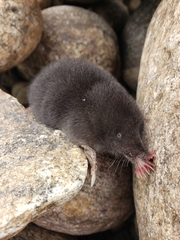
Star-nosed Mole

Star-nosed Mole

Condylura cristata

Silhouette: Didier Descouens (vectorized by T. Michael Keesey) · PhyloPic

LCLeast ConcernNTVUENCR
Daily sighting probability <5% · Rare
at Montreal

In 3 days ~10% in a week ~20%

8 Verified sightings at Montreal
November Best month
☀️ Diurnal When it's spotted

About the Star-nosed Mole

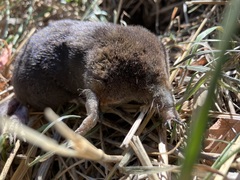
The star-nosed mole (Condylura cristata) is a small semiaquatic mole found in moist, low elevation areas in the northeastern parts of North America. It is the only extant member of the tribe Condylurini and genus Condylura. It has more than 25,000 minute sensory receptors in touch organs, known as Eimer's organs, with which this hamster-sized mole feels its way around. With the help of its Eimer's organs, it may be perfectly poised to detect seismic wave vibrations.

The nose is about 1.5 cm (0.59 in) in diameter with its Eimer's organs distributed on 22 appendages. Eimer's organs were first described in the European mole in 1872 by German zoologist Theodor Eimer. Other mole species also possess Eimer's organs, though they are not as specialized or numerous as in the star-nosed mole. Because the star-nosed mole is functionally blind, the snout was long suspected to be used to detect electrical activity in prey animals, though little, if any, empirical support has been found for this hypothesis. The nasal star and dentition of this species appear to be primarily adapted to exploit extremely small prey. A report in the journal Nature gives this animal the title of fastest-eating mammal, taking as little as 120 milliseconds (average: 227 ms) to identify and consume individual food items. Its brain decides in approximately eight milliseconds if prey is edible or not. This speed is at the limit of the speed of neurons.

These moles are also able to smell underwater, accomplished by exhaling air bubbles onto objects or scent trails and then inhaling the bubbles to carry scents back through the nose. Wikipedia →

Global Distribution

Parks Where Found

# Park Country Daily sighting probability

More parks will be added in future updates.

Cities Where Found

# City Country Daily sighting probability
1 Montreal 🇨🇦 Canada
<5%
2 Toronto 🇨🇦 Canada
<5%

Zoos & Centres Where Found

# Zoo / Centre Country
1 Ralph Perkins II Wildlife Center and Woods Garden 🇺🇸 United States In captivity

Before you go

What are the chances of seeing a Star-nosed Mole in Montreal?

Rare

Under 5% of wildlife watchers report a Star-nosed Mole sighting in Montreal on a given day, based on 8 verified sightings from GBIF citizen-science data. It is the 21st most-seen of the 24 mammals we can rate there. Over three days the chance rises to about 10%, and over a week to about 20%, if each day is a fresh chance.

When is the best time to see a Star-nosed Mole in Montreal?

Any time of year

In every month with enough records, under 5% of wildlife watchers report a Star-nosed Mole in Montreal on a given day, so our monthly data shows no clear season.

What time of day is best to see a Star-nosed Mole?

Between 11 am and 2 pm

Across all the parks we cover, that three-hour window holds the most Star-nosed Mole sightings with a recorded time, and about 9 in 10 of them come between 6 am and 6 pm: it is a daytime animal.

Is Montreal the best place to see a Star-nosed Mole?

Yes

Of the 2 cities where we can rate Star-nosed Mole sightings, Montreal has the highest daily chance: under 5%. Next come Toronto (Canada, under 5%).

Where does the Star-nosed Mole sighting chance come from?

GBIF citizen-science records

It is estimated from how often the Star-nosed Mole is recorded against all the mammals logged in Montreal (8 verified sightings), calibrated against known sighting rates. Figures are rounded to the nearest 10% because citizen-science data supports honest approximations, not decimals, and months with records from fewer than five people show "—". How it works.

← Back to Montreal