Northern Short-tailed Shrew

Northern Short-tailed Shrew

Blarina brevicauda

Silhouette: Becky Barnes · PhyloPic

LCLeast ConcernNTVUENCR
Daily sighting probability ~10% · With luck
at Montreal

In 3 days ~20% in a week ~40%

61 Verified sightings at Montreal
65 In all 5 parks From 2019 to 2026
October Best month
☀️ Diurnal When it's spotted

About the Northern Short-tailed Shrew

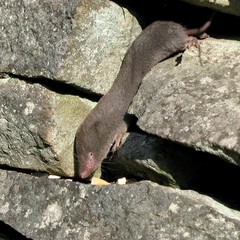
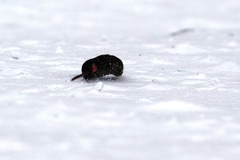
The northern short-tailed shrew (Blarina brevicauda) is the largest shrew in the genus Blarina, and occurs in the northeastern region of North America. It is a semifossorial, highly active, and voracious insectivore and is present in a variety of habitats like broadleaved and pine forests among shrubs and hedges as well as grassy river banks. It is notable in that it is one of the few venomous mammals. The specific epithet, brevicauda, is a combination of the Latin brevis and cauda, meaning "short tail".

B. brevicauda is a red-toothed shrew, one of three or four species (depending on the authority) in the genus Blarina. It was formerly considered to be a sister subspecies of the southern short-tailed shrew (B. carolinensis). The two groups of subspecies are thought to have been kept isolated from each other by Pleistocene glaciers.

This shrew has a total length of 108 to 140 mm (4... Wikipedia →

Sounds

Recording0:16

Canada · 2020

© geoffreyboulange · iNaturalist · CC BY-NC 4.0

Recording0:19

United States · 2024

© Kyle Aldinger · iNaturalist · CC BY-NC 4.0

Recording0:17

Canada · 2024

© math_foo · iNaturalist · CC BY-NC 4.0

Global Distribution

Parks Where Found

# Park Country Daily sighting probability
1 Shenandoah National Park 🇺🇸 United States
~10%
2 Riding Mountain National Park 🇨🇦 Canada
~10%
3 Acadia National Park 🇺🇸 United States
~10%
4 Great Smoky Mountains National Park 🇺🇸 United States
~10%
5 Point Pelee National Park 🇨🇦 Canada
~10%

Cities Where Found

# City Country Daily sighting probability
1 Minneapolis [Saint Paul] 🇺🇸 United States
~10%
2 Washington 🇺🇸 United States
~10%
3 Philadelphia 🇺🇸 United States
~10%
4 Baltimore 🇺🇸 United States
~10%
5 Boston 🇺🇸 United States
~10%
6 Montreal 🇨🇦 Canada
~10%
7 New York City 🇺🇸 United States
~10%
8 Toronto 🇨🇦 Canada
<5%
9 Chicago 🇺🇸 United States
<5%

Zoos & Centres Where Found

# Zoo / Centre Country
1 Ralph Perkins II Wildlife Center and Woods Garden 🇺🇸 United States In captivity

Before you go

What are the chances of seeing a Northern Short-tailed Shrew in Montreal?

With luck

About 10% of wildlife watchers report a Northern Short-tailed Shrew sighting in Montreal on a given day, based on 61 verified sightings from GBIF citizen-science data. It is the 12th most-seen of the 24 mammals we can rate there. Over three days the chance rises to about 20%, and over a week to about 40%, if each day is a fresh chance.

When is the best time to see a Northern Short-tailed Shrew in Montreal?

February, August–October and December

In those months about 10% of wildlife watchers report a Northern Short-tailed Shrew in Montreal on a given day, against under 5% in January, March–July and November, the lowest months.

What time of day is best to see a Northern Short-tailed Shrew?

Between 9 am and noon

Across all the parks we cover, that three-hour window holds the most Northern Short-tailed Shrew sightings with a recorded time, and about 9 in 10 of them come between 6 am and 6 pm: it is a daytime animal.

Is Montreal the best place to see a Northern Short-tailed Shrew?

Among the best

Of the 9 cities where we can rate Northern Short-tailed Shrew sightings, Montreal ranks 6th at about 10%, level with the leaders once rounded. The best odds are in Minneapolis [Saint Paul] (United States, about 10%), Washington (United States, about 10%) and Philadelphia (United States, about 10%).

Where does the Northern Short-tailed Shrew sighting chance come from?

GBIF citizen-science records

It is estimated from how often the Northern Short-tailed Shrew is recorded against all the mammals logged in Montreal (61 verified sightings), calibrated against known sighting rates. Figures are rounded to the nearest 10% because citizen-science data supports honest approximations, not decimals, and months with records from fewer than five people show "—". How it works.


← Back to Montreal