About the Siberian Flying Squirrel
The Siberian flying squirrel (Pteromys volans) is an Old World flying squirrel ranging from the Baltic Sea in the west, throughout Northern Asia to the coast of the Pacific Ocean in the east. It is the only species of flying squirrel in Europe and is considered vulnerable in the European Union where it occurs only in Estonia and Finland. In Latvia, it was last sighted in 2001 and has been considered to be locally extinct since 2013.
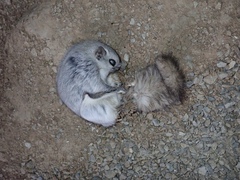
A female Siberian flying squirrel weighs about 150 g (5.3 oz), the males being slightly smaller on average. The body is 13–20 cm (5.1–7.9 in) long, with a 9–14 cm (3.5–5.5 in) long flattened tail. The eyes are large and strikingly black. The coat is grey all over, the abdomen being slightly lighter than the back, with a black stripe between the neck and the forelimb. A distinctive feature of flying squirrels is the furry glide membrane or patagium, a flap of skin that stretches between the front and rear legs. By spreading this membrane the flying squirrel may glide from tree to tree across distances of over a hundred meters, and have been known to record a glide ratio of 3.31, but is normally 1-1.5.
The... Wikipedia →