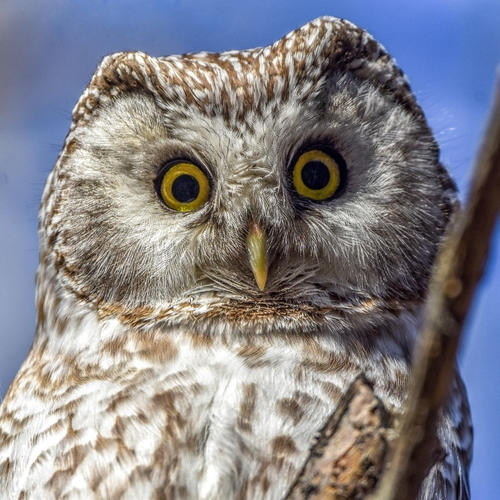
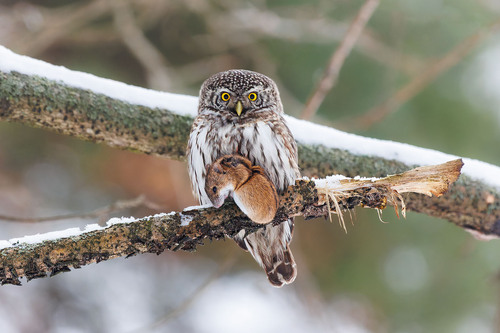
Ural Owl

Ural Owl

Strix uralensis

Silhouette: Sharon Wegner-Larsen · PhyloPic

LCLeast ConcernNTVUENCR
Daily sighting probability ~10% · With luck
at Moscow

In 3 days ~20% in a week ~40%

146 Verified sightings at Moscow
9 In 1 park From 2019 to 2026
December Best month
☀️🌙 Day & Night When it's spotted

About the Ural Owl

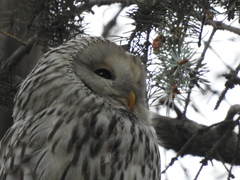
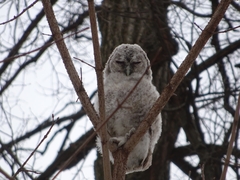
The Ural owl (Strix uralensis) is a large nocturnal owl. It is a member of the true owl family, Strigidae. The Ural owl is a member of the genus Strix, that is also the origin of the family's name under Linnaean taxonomy. Both its common name and scientific name refer to the Ural Mountains of Russia where the type specimen was collected. However, this species has an extremely broad distribution that extends as far west as much of Scandinavia, montane eastern Europe, and, sporadically, central Europe, thence sweeping across the Palearctic broadly through Russia to as far east as Sakhalin and throughout Japan. The Ural owl may include up to 15 subspecies, but most likely the number may be slightly fewer if accounting for clinal variations.

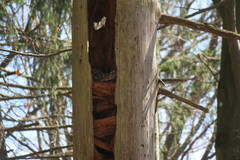
This forest owl is typical associated with the vast taiga forest in Eurosiberia, although it ranges to other forest types, including mixed forests and temperate deciduous forest. The Ural owl is something of a dietary generalist like many members of the Strix genus, but it is usually locally reliant on small mammals, especially small rodents such as voles. In terms of its reproductive habits, Ural owls tend to vigorously protect a set territory on which they have historically nested on a variety of natural nest sites, including tree cavities and stumps and nests originally built by other birds but now, in many parts of the range are adapted to nest boxes made by biologists and conservationists. Breeding success is often strongly correlated with prey populations. The Ural owl is considered to be a stable bird species overall, with a conservation status per the IUCN as a least concern species. Despite some local decreases and extinctions, the Ural owl has been aided in central Europe by reintroductions. Wikipedia →

Sounds

Song0:09

Sweden · 2026

© Lars Edenius · XC1082571 · CC BY-NC-SA 4.0

Call0:38

Latvia · 2008

© Agris Celmins · XC750071 · CC BY-NC-ND 4.0

Begging call0:23

Estonia · 2021

© Uku Paal · XC656594 · CC BY-NC-SA 4.0

Global Distribution

Parks Where Found

# Park Country Daily sighting probability
1 Bavarian Forest National Park 🇩🇪 Germany
~10%

More parks will be added in future updates.

Cities Where Found

# City Country Daily sighting probability
1 Kazan 🇷🇺 Russia
~20%
2 Novosibirsk 🇷🇺 Russia
~20%
3 Saint Petersburg 🇷🇺 Russia
~20%
4 Yekaterinburg 🇷🇺 Russia
~10%
5 Nizhny Novgorod 🇷🇺 Russia
~10%
6 Moscow 🇷🇺 Russia
~10%
7 Tokyo 🇯🇵 Japan
<5%

Zoos & Centres Where Found

# Zoo / Centre Country
1 Moscow Zoo 🇷🇺 Russia In captivity
2 Pairi Daiza 🇧🇪 Belgium In captivity
3 Prague Zoo 🇨🇿 Czechia In captivity
4 Tierpark Berlin 🇩🇪 Germany In captivity
5 Zoorasia 🇯🇵 Japan In captivity
6 Zürich Zoo 🇨🇭 Switzerland In captivity
7 Ostrava Zoo 🇨🇿 Czechia In captivity
8 Zoo Pilsen 🇨🇿 Czechia In captivity
9 Brno Zoo 🇨🇿 Czechia In captivity
10 Yekaterinburg Zoo 🇷🇺 Russia In captivity
11 Ranua Wildlife Park 🇫🇮 Finland In captivity
12 Lusen National Park Centre 🇩🇪 Germany In captivity
13 Espace Rambouillet 🇫🇷 France In captivity
14 Tierpark Sababurg 🇩🇪 Germany In captivity
15 Kadoorie Farm and Botanic Garden 🇭🇰 Hong Kong SAR China In captivity
16 Parc animalier de Sainte-Croix 🇫🇷 France In captivity
17 Saitama Children's Zoo 🇯🇵 Japan In captivity
18 Nuremberg Zoo 🇩🇪 Germany In captivity
19 Tiergarten Am Tiergarten 28 in Nürnberg 🇩🇪 Germany In captivity
20 Wildpark Poing 🇩🇪 Germany In captivity
21 Parco Natura Viva 🇮🇹 Italy In captivity
22 Yaroslavl Zoo 🇷🇺 Russia In captivity
23 Zoo La Barben 🇫🇷 France In captivity
24 Kyiv Zoo 🇺🇦 Ukraine In captivity
25 Wildpark Frankenhof 🇩🇪 Germany In captivity
26 Natur- und Tierpark Goldau 🇨🇭 Switzerland In captivity
27 Cologne Zoological Garden 🇩🇪 Germany In captivity
28 Sapporo Maruyama Zoo 🇯🇵 Japan In captivity
29 Kharkiv Zoo 🇺🇦 Ukraine In captivity
30 London Zoo 🇬🇧 United Kingdom In captivity
31 Ueno Zoo 🇯🇵 Japan In captivity
32 Zoo Veldhoven 🇳🇱 Netherlands In captivity
33 Asahiyama Zoo 🇯🇵 Japan In captivity
34 Minsk Zoo 🇧🇾 Belarus In captivity
35 Plock Zoo 🇵🇱 Poland In captivity
36 Van Blanckendaell Park 🇳🇱 Netherlands In captivity
37 Inokashira Park Zoo 🇯🇵 Japan In captivity
38 Oasi Naturalistica di Sant'Alessio 🇮🇹 Italy In captivity
39 Tierpark Hexentanzplatz 🇩🇪 Germany In captivity
40 Екопарк Ковалівка 🇺🇦 Ukraine In captivity
41 Leningrad Zoo 🇷🇺 Russia In captivity
42 Ménagerie du Jardin des Plantes 🇫🇷 France In captivity
43 Zoopark Limpopo 🇷🇺 Russia In captivity
44 Bayerwald-Tierpark Lohberg 🇩🇪 Germany In captivity
45 Danmarks Fugle Zoo - Frydenlund Fuglepark 🇩🇰 Denmark In captivity
46 Vogelpark Niendorf 🇩🇪 Germany In captivity
47 Small Breeds Farm Park 🇬🇧 United Kingdom In captivity
48 Alpenzoo Innsbruck 🇦🇹 Austria In captivity
49 Greifvogelpark Saarburg 🇩🇪 Germany In captivity
50 Zoo Hirschstetten 🇦🇹 Austria In captivity

Before you go

What are the chances of seeing an Ural Owl in Moscow?

With luck

About 10% of wildlife watchers report an Ural Owl sighting in Moscow on a given day, based on 146 verified sightings from GBIF citizen-science data. It is the 57th most-seen of the 171 birds we can rate there. Over three days the chance rises to about 20%, and over a week to about 40%, if each day is a fresh chance.

When is the best time to see an Ural Owl in Moscow?

June and November–March

In those months about 10% of wildlife watchers report an Ural Owl in Moscow on a given day, against under 5% in April–May and July–October, the lowest months.

What time of day is best to see an Ural Owl?

Between 5 and 8 pm

Across all the parks we cover, that three-hour window holds the most Ural Owl sightings with a recorded time, and about 6 in 10 of them come between 6 am and 6 pm: it is seen both by day and at night.

Is Moscow the best place to see an Ural Owl?

6th of 7

Of the 7 cities where we can rate Ural Owl sightings, Moscow ranks 6th at about 10%. The best odds are in Kazan (Russia, about 20%), Novosibirsk (Russia, about 20%) and Saint Petersburg (Russia, about 20%).

Where does the Ural Owl sighting chance come from?

GBIF citizen-science records

It is estimated from how often the Ural Owl is recorded against all the birds logged in Moscow (146 verified sightings), calibrated against known sighting rates. Figures are rounded to the nearest 10% because citizen-science data supports honest approximations, not decimals, and months with records from fewer than five people show "—". How it works.

← Back to Moscow