Eurasian Pygmy-Owl

Eurasian Pygmy-Owl

Glaucidium passerinum

Silhouette: Edwin Price · PhyloPic

LCLeast ConcernNTVUENCR
Daily sighting probability <5% · Rare
at Moscow

In 3 days <5% in a week ~10%

60 Verified sightings at Moscow
219 In all 3 parks From 2019 to 2026
January Best month
☀️ Diurnal When it's spotted

About the Eurasian Pygmy-Owl

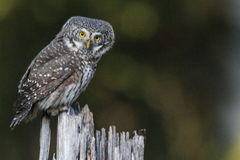
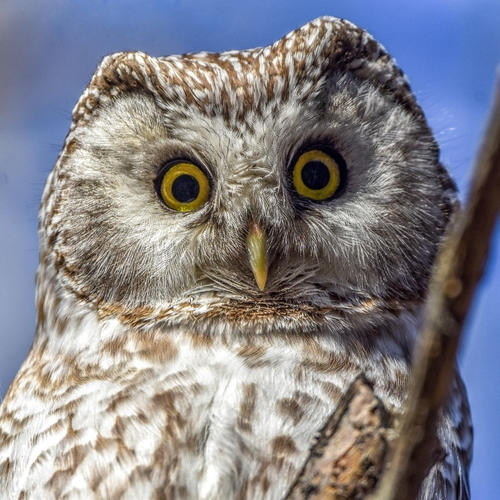
The Eurasian pygmy owl (Glaucidium passerinum) is the smallest owl in Europe. It is dark reddish to greyish-brown, with spotted sides and half of a white ring around the back of the neck. This species is found in the boreal forests of Northern and Central Europe to Siberia.

This is a sedentary species, meaning that adults are resident throughout the year in its range. The exception may be during harsh winters, when the adults may move south. Young of the species usually move in autumn or winter.

The Eurasian pygmy owl was formally described by the Swedish naturalist Carl Linnaeus in 1758 in the tenth edition of his Systema Naturae under the binomial name Strix passerina. The type locality is Sweden. The specific epithet is from Latin passerinus meaning "sparrow-like" implying "sparrow sized". This owl is now placed in the genus Glaucidium that was introduced in 1826 by the German zoologist Friedrich Boie.

Two subspecies are recognised: Glaucidium passerinum passerinum (Linnaeus, 1758) – central, north Europe to southwest Siberia Glaucidium passerinum orientale Taczanowski, 1891 – central, east Siberia, Mongolia and northeast China The Eurasian pygmy... Wikipedia →


Sounds

Song0:40

Sweden · 2022

© Marc Anderson · XC1079574 · CC BY-NC-ND 4.0

Autumn song0:11

Sweden · 2025

© Lars Edenius · XC1045015 · CC BY-NC-SA 4.0

Call0:18

Poland · 2025

© Romuald Mikusek · XC986852 · CC BY-NC-SA 4.0

Global Distribution

Parks Where Found

# Park Country Daily sighting probability
1 Białowieża National Park 🇵🇱 Poland
~20%
2 Ecrins National Park 🇫🇷 France
~10%
3 Bavarian Forest National Park 🇩🇪 Germany
<5%

Cities Where Found

# City Country Daily sighting probability
1 Novosibirsk 🇷🇺 Russia
~10%
2 Moscow 🇷🇺 Russia
<5%
3 Saint Petersburg 🇷🇺 Russia
<5%
4 Minsk 🇧🇾 Belarus
<5%
5 Helsinki 🇫🇮 Finland
<5%

Zoos & Centres Where Found

# Zoo / Centre Country
1 Ähtäri Zoo 🇫🇮 Finland In captivity

Before you go

What are the chances of seeing a Eurasian Pygmy-Owl in Moscow?

Rare

Under 5% of wildlife watchers report a Eurasian Pygmy-Owl sighting in Moscow on a given day, based on 60 verified sightings from GBIF citizen-science data. It is the 110th most-seen of the 171 birds we can rate there. Over three days the chance rises to under 5%, and over a week to about 10%, if each day is a fresh chance.

When is the best time to see a Eurasian Pygmy-Owl in Moscow?

January and February

In those months about 10% of wildlife watchers report a Eurasian Pygmy-Owl in Moscow on a given day, against under 5% in March to December, the lowest months.

What time of day is best to see a Eurasian Pygmy-Owl?

Between 4 and 7 pm

Across all the parks we cover, that three-hour window holds the most Eurasian Pygmy-Owl sightings with a recorded time, and about 8 in 10 of them come between 6 am and 6 pm: it is a daytime animal.

Is Moscow the best place to see a Eurasian Pygmy-Owl?

2nd of 5

Of the 5 cities where we can rate Eurasian Pygmy-Owl sightings, Moscow ranks 2nd at under 5%. The best odds are in Novosibirsk (Russia, about 10%).

Where does the Eurasian Pygmy-Owl sighting chance come from?

GBIF citizen-science records

It is estimated from how often the Eurasian Pygmy-Owl is recorded against all the birds logged in Moscow (60 verified sightings), calibrated against known sighting rates. Figures are rounded to the nearest 10% because citizen-science data supports honest approximations, not decimals, and months with records from fewer than five people show "—". How it works.

← Back to Moscow