About the White-Barred Gold
Micropterix aruncella is a species of moth belonging to the family Micropterigidae, which is distributed throughout Europe. The imago was first described by Giovanni Antonio Scopoli in 1763. This species is one of the best known members of the family, being found in a wide range of habitats from sea level to over 2,000 metres (6,600 ft); the only habitat not favoured by this species is dense woodland.
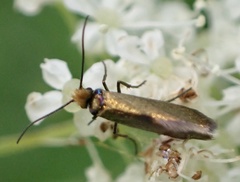
This very small moth has a maximum forewing length of only 4 millimetres (0.16 in). Their wingspan is 6 millimetres (0.24 in) or 7 millimetres (0.28 in). The colour of the forewings is rather variable but is usually reddish golden. Females usually have no other markings but males are marked with two silvery white bands.
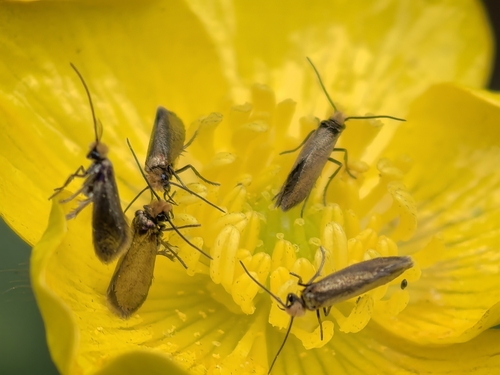
Like other members of the family, this species has functional jaws and it feeds as an adult on pollen grains from a wide variety of flowers including those of hawthorn (Crataegus species), Cytisus, Lychnis, pine (Pinus species), Plantago, rose (Rosa species), nettle (Urtica species) and Veronica as well as numerous grasses. Depending on elevation and latitude, the adults may be encountered in daytime from May to August. They can be found... Wikipedia →