Greater Bandicoot-rat

Greater Bandicoot-rat

Bandicota indica

Silhouette: T. Michael Keesey · PhyloPic

LCLeast ConcernNTVUENCR
Daily sighting probability ~10% · With luck
at Mumbai

In 3 days ~20% in a week ~30%

5 Verified sightings at Mumbai
September Best month

About the Greater Bandicoot-rat

The greater bandicoot rat or Indian bandicoot rat (Bandicota indica) is a species of rodent in the family Muridae found in Bangladesh, China, India, eastern Pakistan, Indonesia, Laos, Malaysia, Myanmar, Nepal, Sri Lanka, Taiwan, Thailand, and Vietnam.

It can grow to about 30–45 cm without including the tail which can grow to 28 cm. These should not be confused with marsupial bandicoots which inhabit Australia and neighbouring New Guinea, which were named after the bandicota rats.

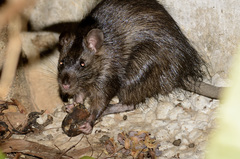
The greater bandicoot rat has a dark gray-brown upper parts with a profusion of long, black hairs. Sides are gray with a few long, black hairs. Short, light gray fur occurs on the ventral surfaces. It has a dark and naked, scaly tail, and dark feet with light-colored claws. The young are much lighter in colour.

In Sinhala, the bandicoot rat is known as maha uru-meeya - මහ ඌරු මීයා, and in Malayalam, it is known as panni-eli - പന്നിയെലി, thorappan തോരപ്പൻ. Both names directly translate to "pig-rat". These are one of several animals called chuchundra in the Nepali language.

A female has between 8 and 10 litters during her life. The young (8–14 rat pups per litter) are born... Wikipedia →

Global Distribution

Parks Where Found

# Park Country Daily sighting probability

More parks will be added in future updates.

Cities Where Found

# City Country Daily sighting probability
1 Bengaluru 🇮🇳 India
~10%
2 Mumbai 🇮🇳 India
~10%

Before you go

What are the chances of seeing a Greater Bandicoot-rat in Mumbai?

With luck

About 10% of wildlife watchers report a Greater Bandicoot-rat sighting in Mumbai on a given day, based on 5 verified sightings from GBIF citizen-science data. It is the 13th most-seen of the 13 mammals we can rate there. Over three days the chance rises to about 20%, and over a week to about 30%, if each day is a fresh chance.

When is the best time to see a Greater Bandicoot-rat in Mumbai?

August–September and December–January

In those months about 10% of wildlife watchers report a Greater Bandicoot-rat in Mumbai on a given day, against under 5% in February–July and October–November, the lowest months.

Is Mumbai the best place to see a Greater Bandicoot-rat?

Among the best

Of the 2 cities where we can rate Greater Bandicoot-rat sightings, Mumbai ranks 2nd at about 10%, level with the leaders once rounded. The best odds are in Bengaluru (India, about 10%).

Where does the Greater Bandicoot-rat sighting chance come from?

GBIF citizen-science records

It is estimated from how often the Greater Bandicoot-rat is recorded against all the mammals logged in Mumbai (5 verified sightings), calibrated against known sighting rates. Figures are rounded to the nearest 10% because citizen-science data supports honest approximations, not decimals, and months with records from fewer than five people show "—". How it works.

← Back to Mumbai