Grey Junglefowl

Grey Junglefowl

Gallus sonneratii

Silhouette: Caleb M. Gordon · PhyloPic

LCLeast ConcernNTVUENCR Endemic
Daily sighting probability <5% · Rare
at Mumbai

In 3 days ~10%

148 Verified sightings at Mumbai
5,405 In all 6 parks From 2019 to 2026
May Best month
🌅 Crepuscular When it's spotted

About the Grey Junglefowl

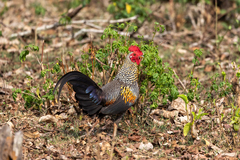
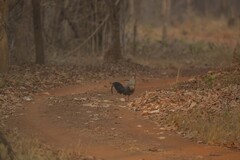
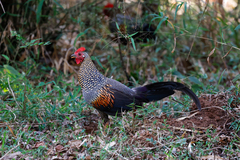
The grey junglefowl (Gallus sonneratii), also known as Sonnerat's junglefowl, is one of the wild ancestors of the domestic chicken together with the red junglefowl and other junglefowls. The species epithet commemorates the French explorer Pierre Sonnerat. Local names include Komri in Rajasthan, Geera kur or Parda komri in Gondi, Jangli Murghi in Hindi, Raan kombdi in Marathi, Kattu Kozhi in Tamil and Malayalam, Kaadu koli in Kannada and Tella adavi kodi in Telugu.

The male has a black cape with ochre spots and the body plumage on a grey ground colour is finely patterned. The elongated neck feathers are dark and end in a small, hard, yellowish plate; this peculiar structure making them popular for making high-grade artificial flies. The male has red wattles and combs but not as strongly developed as in the red junglefowl. Legs of males are red and have spurs while the yellow legs of females usually lack spurs. The central tail feathers are long and sickle shaped. Males have an eclipse plumage in which they moult their colourful neck feathers in summer during or after the breeding season.

The female is duller and has black and white streaking on the underparts and... Wikipedia →

Sounds

Call0:07

India · 2022

© JISHNU KIZHAKKILLAM · XC766803 · CC BY-NC-SA 4.0

Song0:33

India · 1998

© Jelle Scharringa · XC603119 · CC BY-NC-SA 4.0

Call0:42

India · 2022

© Bhaskar Pandeti · XC725327 · CC BY-NC-SA 4.0

Global Distribution

Parks Where Found

# Park Country Daily sighting probability
1 Periyar National Park 🇮🇳 India
~60%
2 Nagarhole National Park 🇮🇳 India
~50%
3 Bandipur National Park 🇮🇳 India
~50%
4 Mudumalai National Park 🇮🇳 India
~40%
5 Satpura National Park 🇮🇳 India
~40%
6 Eravikulam National Park 🇮🇳 India
~10%

Cities Where Found

# City Country Daily sighting probability
1 Mumbai 🇮🇳 India
<5%
2 Coimbatore 🇮🇳 India
<5%
3 Bengaluru 🇮🇳 India
<5%

Zoos & Centres Where Found

# Zoo / Centre Country
1 Taronga Zoo 🇦🇺 Australia In captivity
2 Budapest Zoo & Botanical Garden 🇭🇺 Hungary In captivity
3 Zoo Koki (Parque zoológico y botánico) 🇪🇸 Spain In captivity
4 Zoo Lagos 🇵🇹 Portugal In captivity
5 Avifauna 🇪🇸 Spain In captivity
6 Ogród zoologiczny w Lubinie 🇵🇱 Poland In captivity

Before you go

What are the chances of seeing a Grey Junglefowl in Mumbai?

Rare

Under 5% of wildlife watchers report a Grey Junglefowl sighting in Mumbai on a given day, based on 148 verified sightings from GBIF citizen-science data. It is the 149th most-seen of the 283 birds we can rate there. Over three days the chance rises to about 10%, if each day is a fresh chance.

When is the best time to see a Grey Junglefowl in Mumbai?

May

In that month about 10% of wildlife watchers report a Grey Junglefowl in Mumbai on a given day, against under 5% in June to April, the lowest months. That is one of Mumbai's driest months, with about 20 mm of rain against 830 mm in July.

What time of day is best to see a Grey Junglefowl?

Between 2 and 5 am

Across all the parks we cover, that three-hour window holds the most Grey Junglefowl sightings with a recorded time, and about half of them come between 6 am and 6 pm: it is most active around dawn and dusk.

Is Mumbai the best place to see a Grey Junglefowl?

Yes

Of the 3 cities where we can rate Grey Junglefowl sightings, Mumbai has the highest daily chance: under 5%. Next come Coimbatore (India, under 5%) and Bengaluru (India, under 5%).

Where does the Grey Junglefowl sighting chance come from?

GBIF citizen-science records

It is estimated from how often the Grey Junglefowl is recorded against all the birds logged in Mumbai (148 verified sightings), calibrated against known sighting rates. Figures are rounded to the nearest 10% because citizen-science data supports honest approximations, not decimals, and months with records from fewer than five people show "—". How it works.

← Back to Mumbai