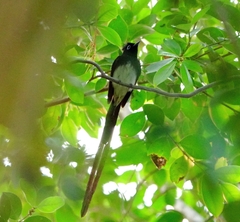
Japanese Paradise-Flycatcher

Japanese Paradise-Flycatcher

Terpsiphone atrocaudata

Silhouette: PhyloPic

LCLeast ConcernNTVUENCR
Daily sighting probability <5% · Rare
at Nagoya

In 3 days <5%

8 Verified sightings at Nagoya
5 In 1 park From 2019 to 2026
August Best month
☀️ Diurnal When it's spotted

About the Japanese Paradise-Flycatcher

The black paradise flycatcher (Terpsiphone atrocaudata), also known as the Japanese paradise flycatcher, is a medium-sized passerine bird native to southeastern Asia. It is a glossy black, chestnut and white bird, slightly smaller than either the Amur paradise flycatcher or Blyth's paradise flycatcher, but similar in appearance. Males have exceptionally long tails. Females are generally duller in appearance and have shorter tails.

It is a migratory species, breeding in Japan, South Korea, Taiwan and the far north of the Philippines. Outside the breeding season it migrates to China, Thailand, Laos, Vietnam, other parts of the Philippines, Malaysia, Singapore, and Sumatra, Indonesia.

The black paradise flycatcher was previously classified with the Old World flycatcher family Muscicapidae, but the paradise-flycatchers, monarch flycatchers and Australasian fantails are now normally grouped with the drongos in the family Dicruridae, which has most of its members in Australasia and tropical southern Asia. Wikipedia →

Sounds

Call0:14

China · 2019

© Bo Shunqi 薄顺奇 · XC841471 · CC BY-NC-SA 4.0

Song0:06

Taiwan · 2020

© Sunny Tseng · XC551815 · CC BY-NC-SA 4.0

Call1:07

Taiwan · 2017

© Gareth K. · XC454973 · CC BY-NC-SA 4.0

Global Distribution

Parks Where Found

# Park Country Daily sighting probability
1 Taman Negara National Park 🇲🇾 Malaysia
<5%

More parks will be added in future updates.

Cities Where Found

# City Country Daily sighting probability
1 Tuen Mun 🇨🇳 China
~10%
2 Xiamen City 🇨🇳 China
<5%
3 Busan 🇰🇷 South Korea
<5%
4 Naha 🇯🇵 Japan
<5%
5 Guangzhou 🇨🇳 China
<5%
6 Suzhou 🇨🇳 China
<5%
7 Hong Kong 🇨🇳 China
<5%
8 Singapore 🇸🇬 Singapore
<5%
9 Kaohsiung 🇹🇼 Taiwan
<5%
10 Shanghai 🇨🇳 China
<5%

Before you go

What are the chances of seeing a Japanese Paradise-Flycatcher in Nagoya?

Rare

Under 5% of wildlife watchers report a Japanese Paradise-Flycatcher sighting in Nagoya on a given day, based on 8 verified sightings from GBIF citizen-science data. It is the 156th most-seen of the 165 birds we can rate there. Over three days the chance rises to under 5%, if each day is a fresh chance.

When is the best time to see a Japanese Paradise-Flycatcher in Nagoya?

Any time of year

In every month with enough records, under 5% of wildlife watchers report a Japanese Paradise-Flycatcher in Nagoya on a given day, so our monthly data shows no clear season.

What time of day is best to see a Japanese Paradise-Flycatcher?

Between 9 am and noon

Across all the parks we cover, that three-hour window holds the most Japanese Paradise-Flycatcher sightings with a recorded time, and nearly all of them come between 6 am and 6 pm: it is a daytime animal.

Is Nagoya the best place to see a Japanese Paradise-Flycatcher?

14th of 16

Of the 16 cities where we can rate Japanese Paradise-Flycatcher sightings, Nagoya ranks 14th at under 5%. The best odds are in Tuen Mun (China, about 10%), Xiamen City (China, under 5%) and Busan (South Korea, under 5%).

Which relatives of the Japanese Paradise-Flycatcher live in Nagoya?

Same order: Passeriformes

The closest relatives of the Japanese Paradise-Flycatcher that you can see in Nagoya (order Passeriformes, Perching Birds) are Carrion Crow (about 90%), Brown-eared Bulbul (about 90%) and Eurasian Tree Sparrow (about 80%), with each one's daily chance of a sighting.

Where does the Japanese Paradise-Flycatcher sighting chance come from?

GBIF citizen-science records

It is estimated from how often the Japanese Paradise-Flycatcher is recorded against all the birds logged in Nagoya (8 verified sightings), calibrated against known sighting rates. Figures are rounded to the nearest 10% because citizen-science data supports honest approximations, not decimals, and months with records from fewer than five people show "—". How it works.

← Back to Nagoya