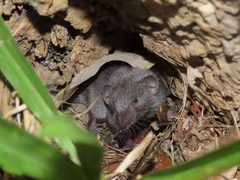
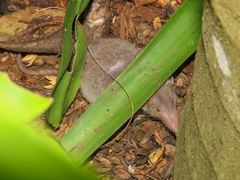
Asian House Shrew

Asian House Shrew

Suncus murinus

Silhouette: Margot Michaud · PhyloPic

LCLeast ConcernNTVUENCR
Daily sighting probability ~30% · Possible
at Naha

In 3 days ~70% in a week ~90%

11 Verified sightings at Naha
June Best month
☀️ Diurnal When it's spotted

About the Asian House Shrew

The Asian house shrew (Suncus murinus) is a shrew species native to South and Southeast Asia that has been listed as Least Concern on the IUCN Red List since 2008 because of its large population and wide distribution. It has been introduced in several West Asian and East African countries. It is considered an invasive species and has been implicated in the demise of several island lizard species.

It is also called house shrew, grey musk shrew, Asian musk shrew or Indian musk shrew. Sorex murinus was the scientific name proposed by Carl Linnaeus in 1766 for a house shrew from Java. In the late 18th to early 20th centuries, several house shrew zoological specimens were described as distinct species that are considered synonyms today:

Sorex myosurus by Peter Simon Pallas in 1781; Sorex viridescens by Edward Blyth in 1859 was a house shrew from the Malabar coast, India; The house shrew has a uniform, short, dense fur of mid-grey to brownish-grey color. The tail is thick at the base and a bit narrower at the tip, and is covered with a few long, bristle-like hairs that are thinly scattered. They have short legs with five clawed toes. They have small external... Wikipedia →

Sounds

Recording0:09

Iraq · 2025

© nature of Nineveh · iNaturalist · CC BY 4.0

Recording0:05

Singapore · 2024

© Axl · iNaturalist · CC BY-NC 4.0

Global Distribution

Parks Where Found

# Park Country Daily sighting probability

More parks will be added in future updates.

Cities Where Found

# City Country Daily sighting probability
1 Naha 🇯🇵 Japan
~30%
2 Jakarta 🇮🇩 Indonesia
~10%
3 Bengaluru 🇮🇳 India
~10%
4 Manila 🇵🇭 Philippines
~10%
5 Tainan 🇹🇼 Taiwan
~10%
6 Pune 🇮🇳 India
~10%
7 Singapore 🇸🇬 Singapore
~10%
8 New Delhi 🇮🇳 India
~10%
9 Guangzhou 🇨🇳 China
~10%
10 Taipei 🇹🇼 Taiwan
<5%

Before you go

What are the chances of seeing an Asian House Shrew in Naha?

Possible

About 30% of wildlife watchers report an Asian House Shrew sighting in Naha on a given day, based on 11 verified sightings from GBIF citizen-science data. Over three days the chance rises to about 70%, and over a week to about 90%, if each day is a fresh chance.

When is the best time to see an Asian House Shrew in Naha?

May and June

In those months about 50% of wildlife watchers report an Asian House Shrew in Naha on a given day, against under 5% in August, October and December–April, the lowest months. Those are among Naha's wettest months, with about 270 mm of rain a month against 60 mm in February.

What time of day is best to see an Asian House Shrew?

Between 11 am and 2 pm

Across all the parks we cover, that three-hour window holds the most Asian House Shrew sightings with a recorded time, and about 7 in 10 of them come between 6 am and 6 pm: it is a daytime animal.

Is Naha the best place to see an Asian House Shrew?

Yes

Of the 11 cities where we can rate Asian House Shrew sightings, Naha has the highest daily chance: about 30%. Next come Jakarta (Indonesia, about 10%) and Bengaluru (India, about 10%).

Where does the Asian House Shrew sighting chance come from?

GBIF citizen-science records

It is estimated from how often the Asian House Shrew is recorded against all the mammals logged in Naha (11 verified sightings), calibrated against known sighting rates. Figures are rounded to the nearest 10% because citizen-science data supports honest approximations, not decimals, and months with records from fewer than five people show "—". How it works.

← Back to Naha