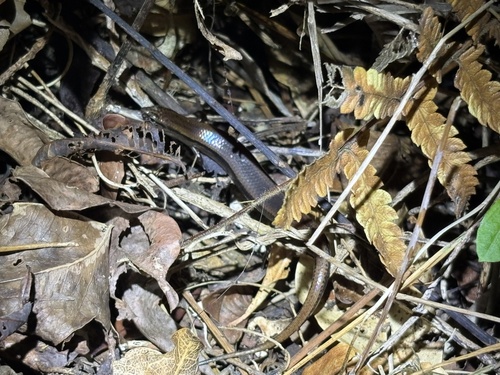
Habu

Habu

Protobothrops flavoviridis

LCLeast ConcernNTVUENCR
Daily sighting probability ~20% · Possible
at Naha

In 3 days ~50% in a week ~80%

5 Verified sightings at Naha
July Best month
🌙 Nocturnal When it's spotted

About the Habu

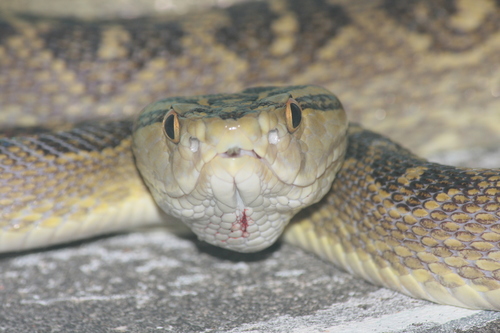
Protobothrops flavoviridis, also known commonly as the Okinawa habu is a species of pit viper, a venomous snake in the subfamily Crotalinae of the family Viperidae. The species is endemic to the Ryukyu Islands of Japan. No subspecies are recognized as being valid. Local common names include habu and Kume Shima habu. The term "habu" in Okinawa Prefecture can also refer to the Sakishima habu (Protobothrops elegans) alternately called the elegant pit viper.

Growing to an average total length (tail included) of 4–5 feet (120–150 cm), with a maximum of 7.9 feet (240 cm), Protobothrops flavoviridis is the largest member of its genus. It is slenderly built and gracefully proportioned with a large head. The crown of the head is covered with small scales. P. flavoviridis has a light olive or brown ground color, overlaid with elongated dark green or brownish blotches. The blotches have yellow edges, sometimes contain yellow spots, and frequently fuse to produce wavy stripes. The belly is whitish with dark coloring along the edges.

The Okinawa habu is restricted to the Japanese Ryukyu Islands, including Okinawa and the Amami Islands... Wikipedia →
Global Distribution

Parks Where Found

# Park Country Daily sighting probability

More parks will be added in future updates.

Cities Where Found

# City Country Daily sighting probability
1 Naha 🇯🇵 Japan
~20%

Zoos & Centres Where Found

# Zoo / Centre Country
1 San Antonio Zoo 🇺🇸 United States In captivity
2 Marine World Uminonakamichi 🇯🇵 Japan In captivity

Before you go

What are the chances of seeing a Habu in Naha?

Possible

About 20% of wildlife watchers report a Habu sighting in Naha on a given day, based on 5 verified sightings from GBIF citizen-science data. It is the 6th most-seen of the 6 reptiles we can rate there. Over three days the chance rises to about 50%, and over a week to about 80%, if each day is a fresh chance.

When is the best time to see a Habu in Naha?

July

In that month about 40% of wildlife watchers report a Habu in Naha on a given day, against under 5% in June, August and October–March, the lowest months.

What time of day is best to see a Habu?

Between 8 and 11 pm

Across all the parks we cover, that three-hour window holds the most Habu sightings with a recorded time, and about 9 in 10 of them come between 6 pm and 6 am: it is mostly seen at night.

Where else can you see a Habu?

Only Naha, in our data

Naha is the only city on Wallace's Line with enough records to rate Habu sightings: about 20% of wildlife watchers there report one on a given day.

Where does the Habu sighting chance come from?

GBIF citizen-science records

It is estimated from how often the Habu is recorded against all the reptiles logged in Naha (5 verified sightings), calibrated against known sighting rates. Figures are rounded to the nearest 10% because citizen-science data supports honest approximations, not decimals, and months with records from fewer than five people show "—". How it works.

← Back to Naha