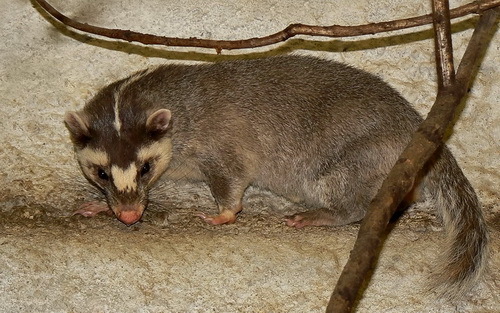
Asian Badger

Asian Badger

Meles leucurus

LCLeast ConcernNTVUENCR
Daily sighting probability ~10% · With luck
at Nanjing

In 3 days ~30% in a week ~50%

8 Verified sightings at Nanjing
November Best month

About the Asian Badger

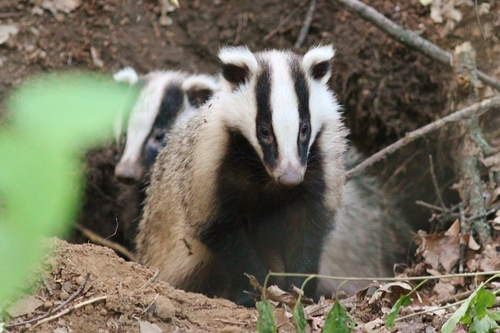
The Asian badger (Meles leucurus), also known as the sand badger, is a species of badger native to Mongolia, China, Kazakhstan, Kyrgyzstan, the Korean Peninsula and Russia. The Asian badger is mostly lighter in colour than the European badger, though some forms may closely approach the former in colour, if not darker, with smudges of ocherous and brownish highlights. The flanks are lighter than the middle of the back, and the facial stripes are usually brown rather than black. The facial stripes narrow behind the eyes and extend above the ears. The white parts of the head are usually dirtier in colour than those of the European badger. The light stripe passing along the top of the head between the two stripes is relatively short and narrow. The Asian badger is generally smaller than the European badger and has relatively longer upper molars. It appears to be the smallest of the three Meles badgers despite regional size variations, with the largest-bodied populations in Siberia. Body mass typically ranges from 3.5 to 9 kg (7.7 to 19.8 lb) and length from 50 to 70 cm (20 to 28 in). The average weight of three adult males from Sobaeksan National Park was 6 kg (13... Wikipedia →

Global Distribution

Parks Where Found

# Park Country Daily sighting probability

More parks will be added in future updates.

Cities Where Found

# City Country Daily sighting probability
1 Nanjing 🇨🇳 China
~10%

Zoos & Centres Where Found

# Zoo / Centre Country
1 Shanghai Zoo 🇨🇳 China In captivity
2 Nanjing Hongshan Forest Zoo 🇨🇳 China In captivity
3 Almaty Zoo 🇰🇿 Kazakhstan In captivity
4 Тюменский зоопарк 🇷🇺 Russia In captivity

Before you go

What are the chances of seeing an Asian Badger in Nanjing?

With luck

About 10% of wildlife watchers report an Asian Badger sighting in Nanjing on a given day, based on 8 verified sightings from GBIF citizen-science data. It is the 7th most-seen of the 8 mammals we can rate there. Over three days the chance rises to about 30%, and over a week to about 50%, if each day is a fresh chance.

When is the best time to see an Asian Badger in Nanjing?

June and October–November

In those months about 20% of wildlife watchers report an Asian Badger in Nanjing on a given day, against under 5% in January–February, April–May and July–August, the lowest months.

Where else can you see an Asian Badger?

Only Nanjing, in our data

Nanjing is the only city on Wallace's Line with enough records to rate Asian Badger sightings: about 10% of wildlife watchers there report one on a given day.

Which relatives of the Asian Badger live in Nanjing?

Same family: Mustelidae

The closest relatives of the Asian Badger that you can see in Nanjing (family Mustelidae, Mustelids) are Siberian Weasel (about 20%) and Small-toothed Ferret Badger (about 10%), with each one's daily chance of a sighting.

Where does the Asian Badger sighting chance come from?

GBIF citizen-science records

It is estimated from how often the Asian Badger is recorded against all the mammals logged in Nanjing (8 verified sightings), calibrated against known sighting rates. Figures are rounded to the nearest 10% because citizen-science data supports honest approximations, not decimals, and months with records from fewer than five people show "—". How it works.
← Back to Nanjing