Siberian Weasel

Siberian Weasel

Mustela sibirica

Silhouette: painting Guo · PhyloPic

LCLeast ConcernNTVUENCR
Daily sighting probability ~20% · Possible
at Nanjing

In 3 days ~50% in a week ~80%

27 Verified sightings at Nanjing
14 In all 2 parks From 2019 to 2026
May Best month
🌅 Crepuscular When it's spotted

About the Siberian Weasel

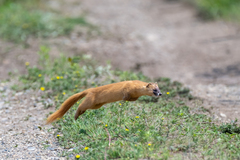
The Siberian weasel or kolonok (Mustela sibirica) is a medium-sized weasel native to Asia, where it is widely distributed and inhabits various forest habitats and open areas. It is therefore listed as least concern on the IUCN Red List.

The Siberian weasel has a long, stretched out body with relatively short legs. Its head is elongated, narrow and relatively small, and its short ears are broad at the base. Its tail is half the length of its body. Its winter fur is very dense, soft and fluffy, with guard hairs reaching 3–4 cm (1.2–1.6 in) in length. The underfur is dense and loose fitting. Siberian weasels are monotone in colour, being bright reddish-ocherous or straw-red, though orange or peach tones are sometimes noticeable on the skin. These tones are especially bright on the back, while the flanks and underbelly are paler. A dark, coffee-brown mask is present on the face. Their tails are more brightly coloured than the back, and are fluffier than those of other members of the genus. The lips and chin are white or slightly ochreous. The front of the muzzle is darker than the remaining parts of the head. Its skull is in several respects intermediate in form between... Wikipedia →

Global Distribution

Parks Where Found

# Park Country Daily sighting probability
1 Jiuzhaigou National Park 🇨🇳 China
~30%
2 Taroko National Park 🇹🇼 Taiwan
~10%

Cities Where Found

# City Country Daily sighting probability
1 Nanjing 🇨🇳 China
~20%
2 Wuhan 🇨🇳 China
~20%
3 Qingdao 🇨🇳 China
~20%
4 Shanghai 🇨🇳 China
~10%
5 Beijing 🇨🇳 China
~10%
6 Hangzhou 🇨🇳 China
~10%
7 Seoul 🇰🇷 South Korea
~10%

Zoos & Centres Where Found

# Zoo / Centre Country
1 Ostrava Zoo 🇨🇿 Czechia In captivity
2 Nanjing Hongshan Forest Zoo 🇨🇳 China In captivity
3 La Torbiera 🇮🇹 Italy In captivity
4 Ouwehands Dierenpark 🇳🇱 Netherlands In captivity
5 Tabor Zoo 🇨🇿 Czechia In captivity

Before you go

What are the chances of seeing a Siberian Weasel in Nanjing?

Possible

About 20% of wildlife watchers report a Siberian Weasel sighting in Nanjing on a given day, based on 27 verified sightings from GBIF citizen-science data. It is the 3rd most-seen of the 8 mammals we can rate there. Over three days the chance rises to about 50%, and over a week to about 80%, if each day is a fresh chance.

When is the best time to see a Siberian Weasel in Nanjing?

May–July and September

In those months about 30% of wildlife watchers report a Siberian Weasel in Nanjing on a given day, against under 5% in February and October–November, the lowest months. Those are among Nanjing's wettest months, with about 150 mm of rain a month against 40 mm in December.

What time of day is best to see a Siberian Weasel?

Between 2 and 5 am

Across all the parks we cover, that three-hour window holds the most Siberian Weasel sightings with a recorded time, and about 6 in 10 of them come between 6 am and 6 pm: it is most active around dawn and dusk.

Is Nanjing the best place to see a Siberian Weasel?

Yes

Of the 7 cities where we can rate Siberian Weasel sightings, Nanjing has the highest daily chance: about 20%. Next come Wuhan (China, about 20%) and Qingdao (China, about 20%).

Which relatives of the Siberian Weasel live in Nanjing?

Same family: Mustelidae

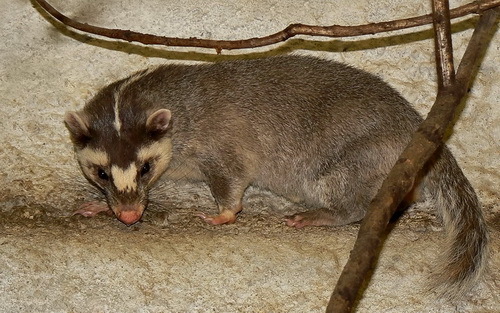
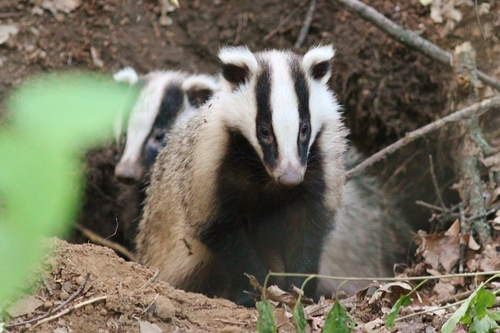
The closest relatives of the Siberian Weasel that you can see in Nanjing (family Mustelidae, Mustelids) are Small-toothed Ferret Badger (about 10%) and Asian Badger (about 10%), with each one's daily chance of a sighting.

Where does the Siberian Weasel sighting chance come from?

GBIF citizen-science records

It is estimated from how often the Siberian Weasel is recorded against all the mammals logged in Nanjing (27 verified sightings), calibrated against known sighting rates. Figures are rounded to the nearest 10% because citizen-science data supports honest approximations, not decimals, and months with records from fewer than five people show "—". How it works.

← Back to Nanjing