About the Oriental Magpie
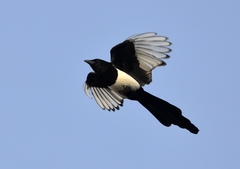
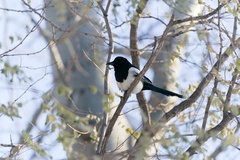
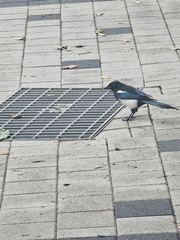
The Oriental magpie (Pica serica) is a species of magpie found from southeastern Russia to eastern China, Korea, Taiwan, and northern Indochina and Myanmar. It is also naturalised in Japan. Other names include Korean magpie, Chinese magpie and Asian magpie. The scientific name serica means "silky [texture]" or "Chinese"; this is the original spelling, though sometimes erroneously "corrected" to sericea.
Like the other magpies, the Oriental magpie is a member of the large radiation of mainly Holarctic corvids, which also includes the typical crows and ravens (Corvus), the nutcrackers (Nucifraga), and the Old World jays. The long tail might be plesiomorphic for this group, as it is also found in the tropical Asian magpies (Cissa and Urocissa) as well as in most of the very basal corvids, such as the treepies. The unique black-and-white pattern of the "monochrome" magpies is an autapomorphy.
The Oriental magpie was first described as a species, based on specimens collected in Amoy (now Xiamen) in southeastern China in 1844. Due to its similarity to the Eurasian magpie in plumage, it was reduced to a synonym of it by Richard Bowdler Sharpe in 1877, and then... Wikipedia →