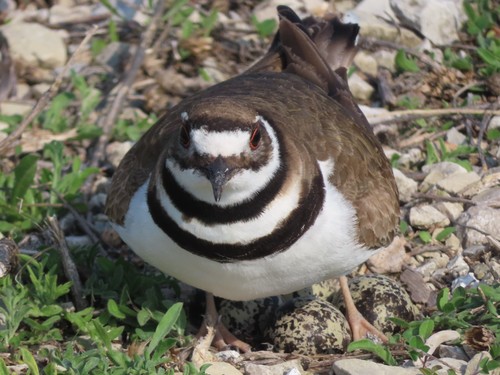
Thick-billed Murre

Thick-billed Murre

Uria lomvia

Silhouette: PhyloPic

LCLeast ConcernNTVUENCR
Daily sighting probability <5% · Rare
at New York City

In 3 days <5%

186 Verified sightings at New York City
2,018 In all 3 parks From 2019 to 2026
April Best month
☀️🌙 Day & Night When it's spotted

About the Thick-billed Murre

The thick-billed murre or Brünnich's guillemot (Uria lomvia) is a bird in the auk family (Alcidae). This bird is named after the Danish zoologist Morten Thrane Brünnich. The very deeply black North Pacific subspecies Uria lomvia arra is also called Pallas' murre after its describer.

The thick-billed murre was formally described in 1758 by the Swedish naturalist Carl Linnaeus in the tenth edition of his Systema Naturae. He placed it with the other auks in the genus Alca and coined the binomial name Alca lomvia. Linnaeus specified the type locality as boreal Europe but this was restricted in 1921 to Greenland by the German ornithologist Ernst Hartert. The thick-billed murre is now placed together with the common murre in the genus Uria that was introduced in 1760 by the French zoologist Mathurin Jacques Brisson. The genus name is from Ancient Greek ouria, a waterbird mentioned by Athenaeus. The specific epithet lomvia is a Swedish word for an auk or diver. The English "guillemot" is from French guillemot probably derived from Guillaume, "William". "Murre" is of uncertain origins, but may imitate the call of the common guillemot.

Four subspecies are recognised: Wikipedia →

Sounds

Call1:17

Norway · 2021

© Stein Ø. Nilsen · XC663988 · CC BY-NC-SA 4.0

Call0:48

Iceland · 2018

© Stanislas Wroza · XC487906 · CC BY-NC-SA 4.0

Call0:25

United States · 2013

© Andrew Spencer · XC141228 · CC BY-NC-SA 3.0

Global Distribution

Parks Where Found

# Park Country Daily sighting probability
1 Svalbard 🇳🇴 Norway
~70%
2 Kenai Fjords National Park 🇺🇸 United States
~10%
3 Acadia National Park 🇺🇸 United States
<5%

Cities Where Found

# City Country Daily sighting probability
1 Boston 🇺🇸 United States
<5%
2 New York City 🇺🇸 United States
<5%

Zoos & Centres Where Found

# Zoo / Centre Country
1 Chimelong Spaceship 🇨🇳 China In captivity
2 Montreal Biodome 🇨🇦 Canada In captivity

Before you go

What are the chances of seeing a Thick-billed Murre in New York City?

Rare

Under 5% of wildlife watchers report a Thick-billed Murre sighting in New York City on a given day, based on 186 verified sightings from GBIF citizen-science data. It is the 294th most-seen of the 359 birds we can rate there. Over three days the chance rises to under 5%, if each day is a fresh chance.

When is the best time to see a Thick-billed Murre in New York City?

Any time of year

In every month with enough records, under 5% of wildlife watchers report a Thick-billed Murre in New York City on a given day, so our monthly data shows no clear season.

What time of day is best to see a Thick-billed Murre?

Between noon and 3 pm

Across all the parks we cover, that three-hour window holds the most Thick-billed Murre sightings with a recorded time, and about 7 in 10 of them come between 6 am and 6 pm: it is seen both by day and at night.

Is New York City the best place to see a Thick-billed Murre?

Among the best

Of the 2 cities where we can rate Thick-billed Murre sightings, New York City ranks 2nd at under 5%, level with the leaders once rounded. The best odds are in Boston (United States, under 5%).

Where does the Thick-billed Murre sighting chance come from?

GBIF citizen-science records

It is estimated from how often the Thick-billed Murre is recorded against all the birds logged in New York City (186 verified sightings), calibrated against known sighting rates. Figures are rounded to the nearest 10% because citizen-science data supports honest approximations, not decimals, and months with records from fewer than five people show "—". How it works.

← Back to New York City