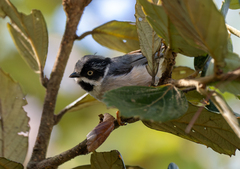
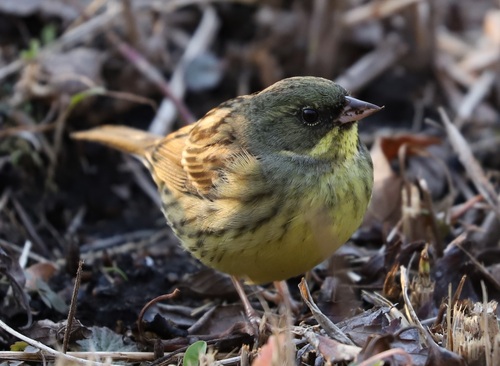
Black-throated Tit

Black-throated Tit

Aegithalos concinnus

Silhouette: Matt Wilkins (photo by Andreas Trepte, www.photo-natur.net) · PhyloPic

LCLeast ConcernNTVUENCR
Daily sighting probability ~30% · Possible
at Ningbo

In 3 days ~60% in a week ~90%

29 Verified sightings at Ningbo
1,459 In all 4 parks From 2019 to 2026
April Best month
🌅 Crepuscular When it's spotted

About the Black-throated Tit

In older sources, "black-throated tit" can also mean the rufous-naped tit or the rufous-vented tit, which are true tits. The black-throated bushtit (Aegithalos concinnus), also known as the black-throated tit, is a very small passerine bird in the family Aegithalidae.

The species has six currently recognised subspecies, and several others have been suggested. Genetic studies have suggested that these subspecies may represent separate species, but further research is needed. The black-throated bushtit is a small passerine, around 10.5 cm (4.1 in) long and weighing 4–9 g (0.14–0.32 oz). There is considerable racial variation in the plumage, but all subspecies have a medium length tail (as opposed to the long tail of the related long-tailed tit), a black throat and a black 'bandit mask' around the eye. The nominate race has a chestnut cap, breast band and flanks and dark grey back, wings and tail, and a white belly. The other subspecies have generally the same pattern (minus the chest band) but with grey caps or all grey bellies and flanks. Both sexes are alike.

It ranges from the foothills of the Himalayas, stretching across... Wikipedia →

Sounds

Song0:15

China · 2026

© Albert Lastukhin · XC1138397 · CC BY-NC-ND 4.0

Call0:17

India · 2019

© Andrew Spencer · XC547750 · CC BY-NC-ND 4.0

Alarm call0:36

Vietnam · 2013

© Patrik Åberg · XC126941 · CC BY-NC-SA 3.0

Global Distribution

Parks Where Found

# Park Country Daily sighting probability
1 Taroko National Park 🇹🇼 Taiwan
~40%
2 Langtang National Park 🇳🇵 Nepal
~30%
3 Royal Manas National Park 🇧🇹 Bhutan
~10%
4 Jim Corbett National Park 🇮🇳 India
~10%

Cities Where Found

# City Country Daily sighting probability
1 Chengdu 🇨🇳 China
~80%
2 Guiyang 🇨🇳 China
~60%
3 Chongqing 🇨🇳 China
~50%
4 Hangzhou 🇨🇳 China
~50%
5 Nanjing 🇨🇳 China
~50%
6 Changsha 🇨🇳 China
~50%
7 Xi'an 🇨🇳 China
~50%
8 Wuhan 🇨🇳 China
~40%
9 Hefei 🇨🇳 China
~40%
10 Kunming 🇨🇳 China
~40%

Before you go

What are the chances of seeing a Black-throated Tit in Ningbo?

Possible

About 30% of wildlife watchers report a Black-throated Tit sighting in Ningbo on a given day, based on 29 verified sightings from GBIF citizen-science data. It is the 25th most-seen of the 61 birds we can rate there. Over three days the chance rises to about 60%, and over a week to about 90%, if each day is a fresh chance.

When is the best time to see a Black-throated Tit in Ningbo?

April

In that month about 50% of wildlife watchers report a Black-throated Tit in Ningbo on a given day, against about 10% in March and September, the lowest months.

What time of day is best to see a Black-throated Tit?

Between 4 and 7 am

Across all the parks we cover, that three-hour window holds the most Black-throated Tit sightings with a recorded time, and about half of them come between 6 am and 6 pm: it is most active around dawn and dusk.

Is Ningbo the best place to see a Black-throated Tit?

12th of 23

Of the 23 cities where we can rate Black-throated Tit sightings, Ningbo ranks 12th at about 30%. The best odds are in Chengdu (China, about 80%), Guiyang (China, about 60%) and Chongqing (China, about 50%).

Which relatives of the Black-throated Tit live in Ningbo?

Same order: Passeriformes

The closest relatives of the Black-throated Tit that you can see in Ningbo (order Passeriformes, Perching Birds) are Chinese Blackbird (about 80%), Light-vented Bulbul (about 80%) and Long-tailed Shrike (about 70%), with each one's daily chance of a sighting.

Where does the Black-throated Tit sighting chance come from?

GBIF citizen-science records

It is estimated from how often the Black-throated Tit is recorded against all the birds logged in Ningbo (29 verified sightings), calibrated against known sighting rates. Figures are rounded to the nearest 10% because citizen-science data supports honest approximations, not decimals, and months with records from fewer than five people show "—". How it works.

← Back to Ningbo