Common Lovebug

Common Lovebug

Plecia nearctica

Daily sighting probability ~10% · With luck
at Orlando

In 3 days ~20% in a week ~50%

54 Verified sightings at Orlando
50 In all 3 parks From 2019 to 2026
September Best month
☀️ Diurnal When it's spotted

About the Common Lovebug

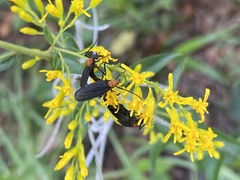
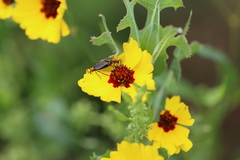
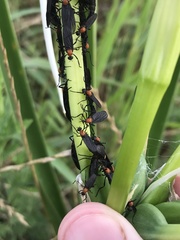
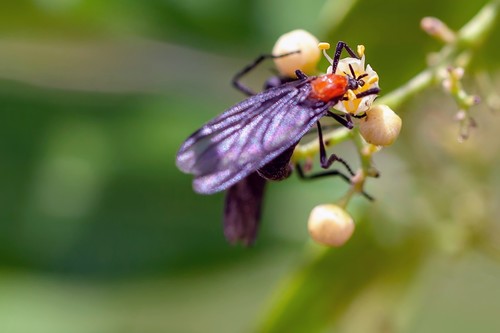
The lovebug (Plecia nearctica) is a species of march fly found in parts of Central America and the southeastern United States, especially along the Gulf Coast. It is also known as the honeymoon fly or double-headed bug. During and after mating, mature pairs remain together, even in flight, for up to several days.

The species was first described in 1940 by D. E. Hardy, though it had been observed in Louisiana as early as 1911. At the time, Hardy reported the distribution of lovebugs to be widespread, but more common in Texas and Louisiana than other Gulf States. By the end of the 20th century, the species had spread to all areas bordering the Gulf of Mexico, the entirety of Florida, and had spread as far as Georgia and South Carolina. L. A. Hetrick, writing in 1970, found the bug was also widespread in central and northern Florida and described its flights as reaching altitudes of 300 to 450 meters (980 to 1,480 ft) and extending several kilometers over the Gulf.

Lovebug larvae feed on partially decayed vegetation in the landscape and, in this respect, are beneficial to humans. Adults primarily feed on nectar from various plants, particularly sweet clover, goldenrod, and Brazilian pepper. The lovebug is considered a nuisance by many motorists, especially in the state of Florida, due to its swarming behavior during the species' mating season. Wikipedia →
Global Distribution

Parks Where Found

# Park Country Daily sighting probability
1 Merritt Island National Wildlife Refuge 🇺🇸 United States
~10%
2 Big Cypress National Preserve 🇺🇸 United States
~10%
3 Everglades National Park 🇺🇸 United States
~10%

Cities Where Found

# City Country Daily sighting probability
1 Houston 🇺🇸 United States
~10%
2 Orlando 🇺🇸 United States
~10%
3 Miami 🇺🇸 United States
<5%

Before you go

What are the chances of seeing a Common Lovebug in Orlando?

With luck

About 10% of wildlife watchers report a Common Lovebug sighting in Orlando on a given day, based on 54 verified sightings from GBIF citizen-science data. It is the 34th most-seen of the 294 insects we can rate there. Over three days the chance rises to about 20%, and over a week to about 50%, if each day is a fresh chance.

When is the best time to see a Common Lovebug in Orlando?

May and September

In those months about 20% of wildlife watchers report a Common Lovebug in Orlando on a given day, against under 5% in June–August and November–March, the lowest months.

What time of day is best to see a Common Lovebug?

Between 9 am and noon

Across all the parks we cover, that three-hour window holds the most Common Lovebug sightings with a recorded time, and about 9 in 10 of them come between 6 am and 6 pm: it is a daytime animal.

Is Orlando the best place to see a Common Lovebug?

Among the best

Of the 3 cities where we can rate Common Lovebug sightings, Orlando ranks 2nd at about 10%, level with the leaders once rounded. The best odds are in Houston (United States, about 10%).

Which relatives of the Common Lovebug live in Orlando?

Same order: Diptera

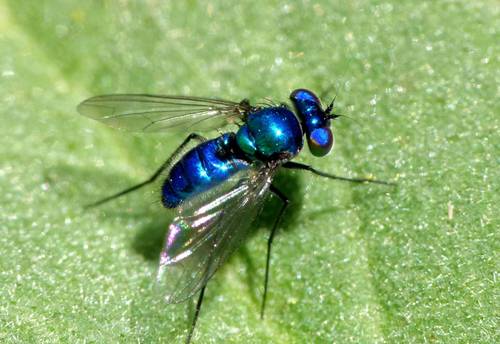
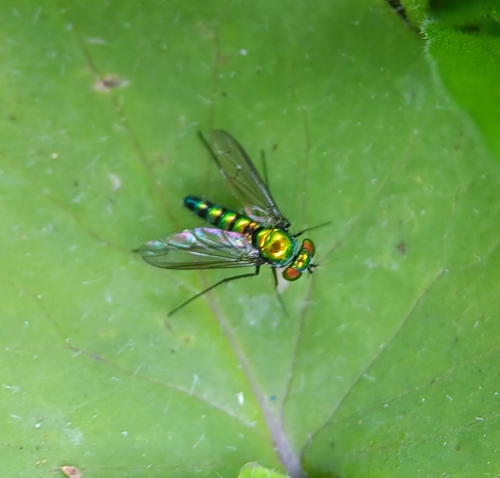
The closest relatives of the Common Lovebug that you can see in Orlando (order Diptera, Flies) are Condylostylus mundus (about 10%) and Florida Calligrapher (about 10%), with each one's daily chance of a sighting.

Where does the Common Lovebug sighting chance come from?

GBIF citizen-science records

It is estimated from how often the Common Lovebug is recorded against all the insects logged in Orlando (54 verified sightings), calibrated against known sighting rates. Figures are rounded to the nearest 10% because citizen-science data supports honest approximations, not decimals, and months with records from fewer than five people show "—". How it works.

← Back to Orlando