Two-toed Amphiuma

Two-toed Amphiuma

Amphiuma means

Silhouette: Johann Wagler · PhyloPic

LCLeast ConcernNTVUENCR Endemic
Daily sighting probability <5% · Rare
at Orlando

In 3 days ~10% in a week ~20%

6 Verified sightings at Orlando
17 In 1 park From 2019 to 2026
July Best month
☀️🌙 Day & Night When it's spotted

About the Two-toed Amphiuma

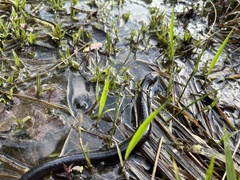
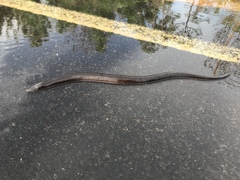
The two-toed amphiuma (Amphiuma means) is an aquatic salamander widely distributed in the southeastern United States. It is commonly, but incorrectly, called "congo snake", "conger eel" or the "blind eel". Two-toed amphiumas are the most prominent in the Amphiumidae family and the longest salamander species in the United States, that can grow from 39 to 1,042 g (1.4 to 36.8 oz) in mass and from 34.8 to 116 cm (13.7 to 45.7 in) in length. They have four vestigial legs that end in two toes; the number of toes is one of the primary differences between Amphiuma means and its relatives, the one-toed and three-toed amphiumas. Additional genetic studies have been conducted on the three species; genetic distance estimates suggest that there is high levels of similarity between two-toed amphiumas and three-toed amphiumas, and much greater dissimilarity between the one-toed amphiuma and the two-toed amphiuma. The head is pointed and wedge-shaped, and the eyes are small. Adults retain a single gill slit on each side of the head. They are black, dark grey or dark brown in color. Two-toed amphiumas tend to be unicolored. Their dark dorsum contrasts with their slightly lighter ventrum... Wikipedia →

Global Distribution

Parks Where Found

# Park Country Daily sighting probability
1 Big Cypress National Preserve 🇺🇸 United States
~20%

More parks will be added in future updates.

Cities Where Found

# City Country Daily sighting probability
1 Orlando 🇺🇸 United States
<5%

Zoos & Centres Where Found

# Zoo / Centre Country
1 Cincinnati Zoo and Botanical Garden 🇺🇸 United States In captivity
2 Riverbanks Zoo 🇺🇸 United States In captivity
3 Alabama Gulf Coast Zoo 🇺🇸 United States In captivity
4 Reptile Gardens 🇺🇸 United States In captivity

Before you go

What are the chances of seeing a Two-toed Amphiuma in Orlando?

Rare

Under 5% of wildlife watchers report a Two-toed Amphiuma sighting in Orlando on a given day, based on 6 verified sightings from GBIF citizen-science data. It is the 9th most-seen of the 10 amphibians we can rate there. Over three days the chance rises to about 10%, and over a week to about 20%, if each day is a fresh chance.

When is the best time to see a Two-toed Amphiuma in Orlando?

January–February and July

In those months about 10% of wildlife watchers report a Two-toed Amphiuma in Orlando on a given day, against under 5% in March–June and August–December, the lowest months.

What time of day is best to see a Two-toed Amphiuma?

Between 9 am and noon

Across all the parks we cover, that three-hour window holds the most Two-toed Amphiuma sightings with a recorded time, and about half of them come between 6 am and 6 pm: it is seen both by day and at night.

Where else can you see a Two-toed Amphiuma?

Only Orlando, in our data

Orlando is the only city on Wallace's Line with enough records to rate Two-toed Amphiuma sightings: under 5% of wildlife watchers there report one on a given day.

Where does the Two-toed Amphiuma sighting chance come from?

GBIF citizen-science records

It is estimated from how often the Two-toed Amphiuma is recorded against all the amphibians logged in Orlando (6 verified sightings), calibrated against known sighting rates. Figures are rounded to the nearest 10% because citizen-science data supports honest approximations, not decimals, and months with records from fewer than five people show "—". How it works.

← Back to Orlando