Squirrel Tree Frog

Squirrel Tree Frog

Dryophytes squirellus

Silhouette: Robbi Bishop-Taylor · PhyloPic

LCLeast ConcernNTVUENCR
Daily sighting probability ~10% · With luck
at Orlando

In 3 days ~20% in a week ~30%

22 Verified sightings at Orlando
200 In all 4 parks From 2019 to 2026
July Best month
☀️🌙 Day & Night When it's spotted

About the Squirrel Tree Frog

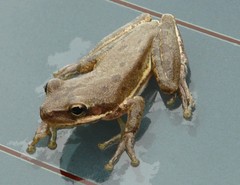
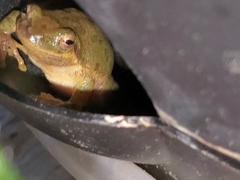
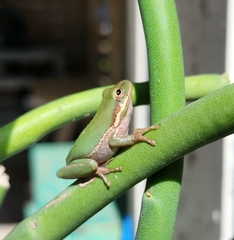
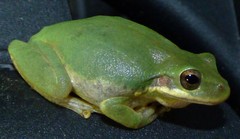
The squirrel tree frog (Dryophytes squirellus) is a small species of tree frog found in the southeastern United States, from Texas to Virginia. It is an introduced species to the Bahamas. Squirrel tree frogs are small frogs, about 1.5 inches in length as adults. There are several color variations, but most commonly they are green and look very much like the American green tree frog. They can also be varying shades of yellow or brown, sometimes with white or brown blotching. Males may also possess a relatively large, conspicuous lateral body stripe, with thicker stripes being more attractive to female frogs.

As a tadpole, the squirrel tree frog is preyed upon by dragonfly nymphs, giant water bugs, predatory fish and newts. Once the tadpoles metamorphose, the predators of the frogs change to small mammals, other frogs, snakes, and birds.

To reduce the danger of being eaten as tadpoles, they use dense vegetation as cover. However, they do not appear to reduce activity within this cover. It has been suggested that the drying of the ponds is a more significant threat to the frogs than predation. As adults, they use their diminutive size and color-changing ability to avoid... Wikipedia →

Sounds

Advertisement call0:11

United States · 2015

© Chris Harrison · XC890901 · CC BY-NC-SA 4.0

Recording0:20

United States · 2026

© jagawong · iNaturalist · CC BY-NC 4.0

Recording0:33

United States · 2026

© Matt Felperin · iNaturalist · CC BY 4.0

Global Distribution

Parks Where Found

# Park Country Daily sighting probability
1 Big Cypress National Preserve 🇺🇸 United States
~30%
2 Congaree National Park 🇺🇸 United States
~20%
3 Padre Island National Seashore 🇺🇸 United States
~10%
4 Everglades National Park 🇺🇸 United States
~10%

Cities Where Found

# City Country Daily sighting probability
1 Houston 🇺🇸 United States
~10%
2 Orlando 🇺🇸 United States
~10%
3 Miami 🇺🇸 United States
<5%
4 Austin 🇺🇸 United States
<5%

Zoos & Centres Where Found

# Zoo / Centre Country
1 Bioparque Municipal Vesty Pakos 🇧🇴 Bolivia In captivity
2 Western North Carolina Nature Center 🇺🇸 United States In captivity
3 South Carolina Aquarium 🇺🇸 United States In captivity
4 Children's Aquarium at Fair Park 🇺🇸 United States In captivity

Before you go

What are the chances of seeing a Squirrel Tree Frog in Orlando?

With luck

About 10% of wildlife watchers report a Squirrel Tree Frog sighting in Orlando on a given day, based on 22 verified sightings from GBIF citizen-science data. It is the 7th most-seen of the 10 amphibians we can rate there. Over three days the chance rises to about 20%, and over a week to about 30%, if each day is a fresh chance.

When is the best time to see a Squirrel Tree Frog in Orlando?

February and April–August

In those months about 10% of wildlife watchers report a Squirrel Tree Frog in Orlando on a given day, against under 5% in March and September–January, the lowest months.

What time of day is best to see a Squirrel Tree Frog?

Between 8 and 11 pm

Across all the parks we cover, that three-hour window holds the most Squirrel Tree Frog sightings with a recorded time, and about 6 in 10 of them come between 6 pm and 6 am: it is seen both by day and at night.

Is Orlando the best place to see a Squirrel Tree Frog?

Among the best

Of the 4 cities where we can rate Squirrel Tree Frog sightings, Orlando ranks 2nd at about 10%, level with the leaders once rounded. The best odds are in Houston (United States, about 10%).

Where does the Squirrel Tree Frog sighting chance come from?

GBIF citizen-science records

It is estimated from how often the Squirrel Tree Frog is recorded against all the amphibians logged in Orlando (22 verified sightings), calibrated against known sighting rates. Figures are rounded to the nearest 10% because citizen-science data supports honest approximations, not decimals, and months with records from fewer than five people show "—". How it works.

← Back to Orlando