Green Pheasant

Green Pheasant

Phasianus versicolor

Silhouette: Mattia Menchetti · PhyloPic

LCLeast ConcernNTVUENCR Endemic
Daily sighting probability <5% · Rare
at Osaka

In 3 days <5% in a week ~10%

44 Verified sightings at Osaka
11 In 1 park From 2019 to 2026
August Best month
🌅 Crepuscular When it's spotted

About the Green Pheasant

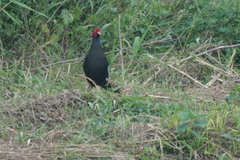
The green pheasant (Phasianus versicolor), also known as the Japanese green pheasant or Kiji, is an omnivorous bird native to the Japanese archipelago, to which it is endemic. Some taxonomic authorities consider it a subspecies of the common pheasant, Phasianus colchicus. It is the national bird of Japan.

Some sources claim that the green pheasant is a subspecies of the common pheasant, though others claim that they are separate, though closely related, species. The green pheasant has three subspecies. The nominate subspecies, P. v. versicolor, is called the southern green pheasant or kiji. There are some cases of hybrids between the green pheasant and the copper pheasant or common pheasant. Interbreeding of between green and common pheasants is the origin of a melanistic variant of common pheasant found in English populations.

The male (cock) southern green pheasant, P. v. versicolor, has dark green plumage on the breast, neck, mantle, and flanks. The male also has a bluish-purplish hood with clear ear tufts, red... Wikipedia →

Sounds

Call0:04

Japan · 2000

© Desmond Allen · XC79388 · CC BY-NC-ND 2.5

Recording0:01

Japan · 2026

© kinocokoutei · iNaturalist · CC BY-NC 4.0

Recording0:10

Japan · 2025

© Masashi Hosotani · iNaturalist · CC BY-NC 4.0

Global Distribution

Parks Where Found

# Park Country Daily sighting probability
1 Nikko National Park 🇯🇵 Japan
<5%

More parks will be added in future updates.

Cities Where Found

# City Country Daily sighting probability
1 Sendai 🇯🇵 Japan
~20%
2 Nagoya 🇯🇵 Japan
~10%
3 Tokyo 🇯🇵 Japan
~10%
4 Osaka 🇯🇵 Japan
<5%

Zoos & Centres Where Found

# Zoo / Centre Country
1 Zoo Pilsen 🇨🇿 Czechia In captivity
2 Guangzhou Zoo 🇨🇳 China In captivity
3 Yerevan Zoo 🇦🇲 Armenia In captivity
4 Saigon Zoo and Botanical Gardens 🇻🇳 Vietnam In captivity
5 Ueno Zoo 🇯🇵 Japan In captivity
6 Bird Park 🇮🇳 India In captivity
7 World of Birds Wildlife Sanctuary and Monkey Park 🇿🇦 South Africa In captivity
8 Ecozoológico San Martín 🇪🇨 Ecuador In captivity
9 Zoo Koki (Parque zoológico y botánico) 🇪🇸 Spain In captivity
10 Avifauna 🇪🇸 Spain In captivity
11 Bali Bird Park 🇮🇩 Indonesia In captivity

Before you go

What are the chances of seeing a Green Pheasant in Osaka?

Rare

Under 5% of wildlife watchers report a Green Pheasant sighting in Osaka on a given day, based on 44 verified sightings from GBIF citizen-science data. It is the 112th most-seen of the 180 birds we can rate there. Over three days the chance rises to under 5%, and over a week to about 10%, if each day is a fresh chance.

When is the best time to see a Green Pheasant in Osaka?

Any time of year

In every month with enough records, under 5% of wildlife watchers report a Green Pheasant in Osaka on a given day, so our monthly data shows no clear season.

What time of day is best to see a Green Pheasant?

Between 4 and 7 am

Across all the parks we cover, that three-hour window holds the most Green Pheasant sightings with a recorded time, and about 6 in 10 of them come between 6 am and 6 pm: it is most active around dawn and dusk.

Is Osaka the best place to see a Green Pheasant?

4th of 4

Of the 4 cities where we can rate Green Pheasant sightings, Osaka ranks 4th at under 5%. The best odds are in Sendai (Japan, about 20%), Nagoya (Japan, about 10%) and Tokyo (Japan, about 10%).

Where does the Green Pheasant sighting chance come from?

GBIF citizen-science records

It is estimated from how often the Green Pheasant is recorded against all the birds logged in Osaka (44 verified sightings), calibrated against known sighting rates. Figures are rounded to the nearest 10% because citizen-science data supports honest approximations, not decimals, and months with records from fewer than five people show "—". How it works.

← Back to Osaka