Japanese Common Plataspid Stinkbug

Japanese Common Plataspid Stinkbug

Megacopta punctatissima

Daily sighting probability ~10% · With luck
at Osaka

In 3 days ~20% in a week ~40%

23 Verified sightings at Osaka
November Best month

About the Japanese Common Plataspid Stinkbug

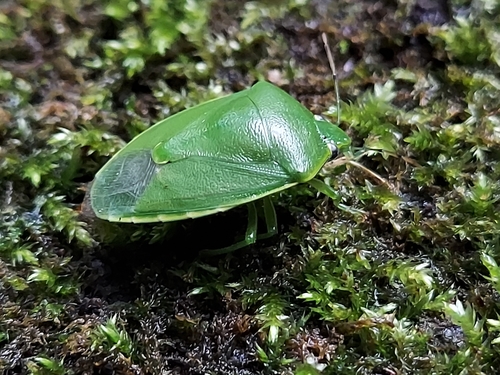
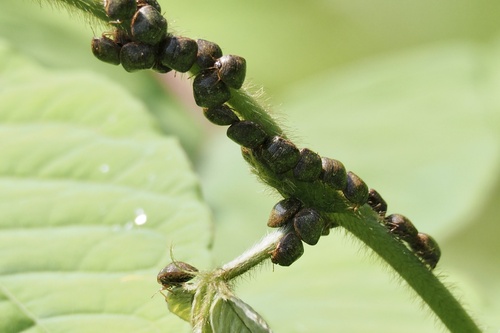
Megacopta cribraria, also called the bean plataspid, kudzu bug, globular stink bug and lablab bug, is a shield bug native to India and China, where it is an agricultural pest of lablab beans and other legumes. The bug, while harmless to houseplants and people, often enters houses. It is attracted to white surfaces such as the walls of houses or white vehicles, because of the high reflectance of the white surfaces as it relates to the bugs' simple eyes. As a defense mechanism, they emit a foul-smelling pheromone that also acts as a congregation pheromone. Aside from smelling foul, the liquid also creates a burning sensation and sometimes leaves a red welt on bare skin. It is similar to other Plataspidae in having a somewhat unusual symbiotic relationship with its gut bacteria. Before laying eggs, females deposit particles containing the symbiont, which are then eaten by newly hatched nymphs under natural conditions. Nymphs experimentally deprived of access to the symbiont exhibited slower growth, smaller body sizes and higher mortality.

Megacopta punctatissima, the Japanese common stinkbug, is a name applied to Japanese populations of M. cribraria. It has a gut bacteria that allows it to consume crops such as soybean plants. The two used to be treated as distinct species, but phylogenetic work has found the two to be not distinct. What is called M. cribraria in the United States likely descends from a population of "M. punctatissima" from Kyushu, Japan. The Japanese (JA) population is closest to the East Asian continental (EAC) population. The two diverged 0.71 Mya (million years ago), when the East China Sea land bridge became submerged. The EAC population branched off from the Southeast Asian (SEA) population 1.34 Mya.

The bean plataspid gives off an offensive odor when touched, squashed, or poked. Hosted by wisteria, green beans, and other legumes, the insect sucks juice from the stems of soybean plants and reduces crop yield. However, when the insect infests kudzu, another invasive species, it appreciably reduces the growth of that plant. Wikipedia →
Global Distribution

Parks Where Found

# Park Country Daily sighting probability

More parks will be added in future updates.

Cities Where Found

# City Country Daily sighting probability
1 Nagoya 🇯🇵 Japan
~30%
2 Sendai 🇯🇵 Japan
~20%
3 Fukuoka 🇯🇵 Japan
~10%
4 Tokyo 🇯🇵 Japan
~10%
5 Osaka 🇯🇵 Japan
~10%

Before you go

What are the chances of seeing a Japanese Common Plataspid Stinkbug in Osaka?

With luck

About 10% of wildlife watchers report a Japanese Common Plataspid Stinkbug sighting in Osaka on a given day, based on 23 verified sightings from GBIF citizen-science data. It is the 107th most-seen of the 352 insects we can rate there. Over three days the chance rises to about 20%, and over a week to about 40%, if each day is a fresh chance.

When is the best time to see a Japanese Common Plataspid Stinkbug in Osaka?

April and June–November

In those months about 10% of wildlife watchers report a Japanese Common Plataspid Stinkbug in Osaka on a given day, against under 5% in May and December–March, the lowest months.

Is Osaka the best place to see a Japanese Common Plataspid Stinkbug?

5th of 5

Of the 5 cities where we can rate Japanese Common Plataspid Stinkbug sightings, Osaka ranks 5th at about 10%. The best odds are in Nagoya (Japan, about 30%), Sendai (Japan, about 20%) and Fukuoka (Japan, about 10%).

Which relatives of the Japanese Common Plataspid Stinkbug live in Osaka?

Same order: Hemiptera

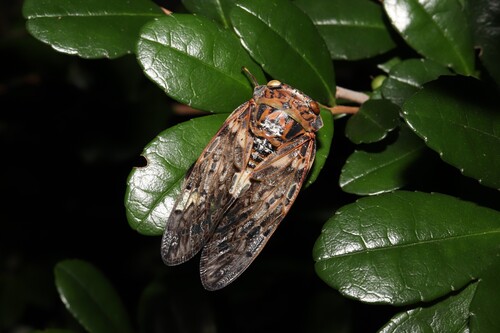
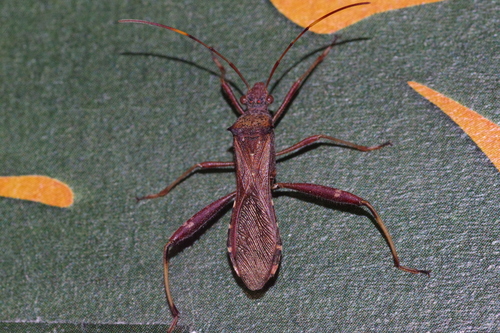
The closest relatives of the Japanese Common Plataspid Stinkbug that you can see in Osaka (order Hemiptera, True Bugs, Hoppers, Aphids, and allies) are Black Giant Cicada (about 30%), Yellow-Spotted Stink Bug (about 30%) and Large Brown Cicada (about 30%), with each one's daily chance of a sighting.

Where does the Japanese Common Plataspid Stinkbug sighting chance come from?

GBIF citizen-science records

It is estimated from how often the Japanese Common Plataspid Stinkbug is recorded against all the insects logged in Osaka (23 verified sightings), calibrated against known sighting rates. Figures are rounded to the nearest 10% because citizen-science data supports honest approximations, not decimals, and months with records from fewer than five people show "—". How it works.

← Back to Osaka