Japanese Keelback

Japanese Keelback

Hebius vibakari

Silhouette: Alex Slavenko · PhyloPic

LCLeast ConcernNTVUENCR
Daily sighting probability ~10% · With luck
at Osaka

In 3 days ~10% in a week ~30%

7 Verified sightings at Osaka
August Best month
☀️ Diurnal When it's spotted

About the Japanese Keelback

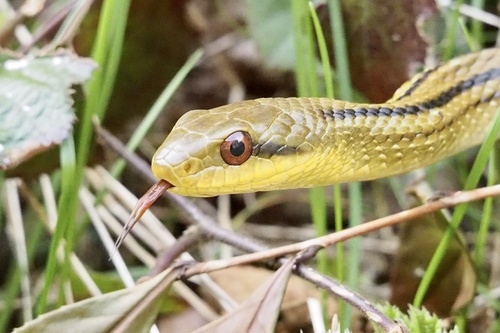
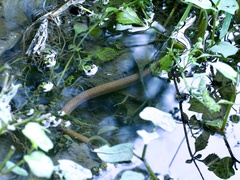
The Japanese keelback (Hebius vibakari), sometimes called the ringed snake or water snake, is a species of colubrid snake, which is endemic to Asia. It was first described in 1826 by Heinrich Boie as Tropidonotus vibakari.

It is found in northeastern China, Japan (Honshu, Kyushu, Shikoku), Korea, and Russia (Amur Oblast, Khabarovsk Krai, Primorsky Krai). It is a small snake, growing to a maximum total length of 44 cm (17+1⁄4 in), with a tail 10 cm (3+7⁄8 in) long.

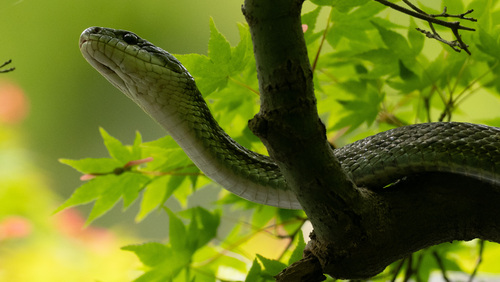
Dorsally it is olive or reddish brown, with small blackish spots. Some specimens may have a dark olive or blackish vertebral stripe. The upper labials are yellow, with black sutures. On each side of the nape of the neck there is a yellow dark-edged diagonal streak, these two streaks converging posteriorly. Ventrally it is yellow, with a series of brown dots or short lines at the outer ends of the ventral scales.

Dorsal scales strongly keeled (except outer row), arranged in 19 rows at midbody. Ventrals 127–151; anal plate divided; subcaudals divided 59–79. Wikipedia →

Global Distribution

Parks Where Found

# Park Country Daily sighting probability

More parks will be added in future updates.

Cities Where Found

# City Country Daily sighting probability
1 Busan 🇰🇷 South Korea
~20%
2 Nagoya 🇯🇵 Japan
~20%
3 Tokyo 🇯🇵 Japan
~10%
4 Osaka 🇯🇵 Japan
~10%

Zoos & Centres Where Found

# Zoo / Centre Country
1 Inokashira Park Zoo 🇯🇵 Japan In captivity

Before you go

What are the chances of seeing a Japanese Keelback in Osaka?

With luck

About 10% of wildlife watchers report a Japanese Keelback sighting in Osaka on a given day, based on 7 verified sightings from GBIF citizen-science data. It is the 12th most-seen of the 12 reptiles we can rate there. Over three days the chance rises to about 10%, and over a week to about 30%, if each day is a fresh chance.

When is the best time to see a Japanese Keelback in Osaka?

August

In that month about 20% of wildlife watchers report a Japanese Keelback in Osaka on a given day, against under 5% in July and September–April, the lowest months.

What time of day is best to see a Japanese Keelback?

Between 2 and 5 pm

Across all the parks we cover, that three-hour window holds the most Japanese Keelback sightings with a recorded time, and about 7 in 10 of them come between 6 am and 6 pm: it is a daytime animal.

Is Osaka the best place to see a Japanese Keelback?

4th of 4

Of the 4 cities where we can rate Japanese Keelback sightings, Osaka ranks 4th at about 10%. The best odds are in Busan (South Korea, about 20%), Nagoya (Japan, about 20%) and Tokyo (Japan, about 10%).

Where does the Japanese Keelback sighting chance come from?

GBIF citizen-science records

It is estimated from how often the Japanese Keelback is recorded against all the reptiles logged in Osaka (7 verified sightings), calibrated against known sighting rates. Figures are rounded to the nearest 10% because citizen-science data supports honest approximations, not decimals, and months with records from fewer than five people show "—". How it works.

← Back to Osaka