
Japanese Rat Snake

Japanese Rat Snake

Elaphe climacophora

Silhouette: Alex Slavenko · PhyloPic

LCLeast ConcernNTVUENCR
Daily sighting probability ~10% · With luck
at Osaka

In 3 days ~30% in a week ~60%

34 Verified sightings at Osaka
5 In 1 park From 2019 to 2026
June Best month
☀️ Diurnal When it's spotted

About the Japanese Rat Snake

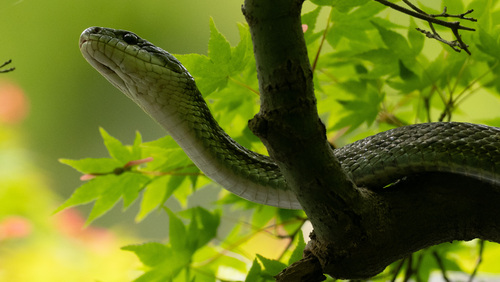
The Japanese rat snake (Elaphe climacophora) is a medium-sized colubrid snake found throughout the Japanese archipelago (except the far South West) as well as on the Russian-administered Kunashir Island. In Japanese it is known as the aodaishō or "blue general". It is non-venomous and is hunted by eagles and tanukis.

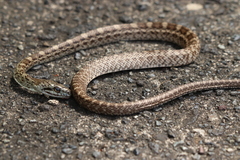
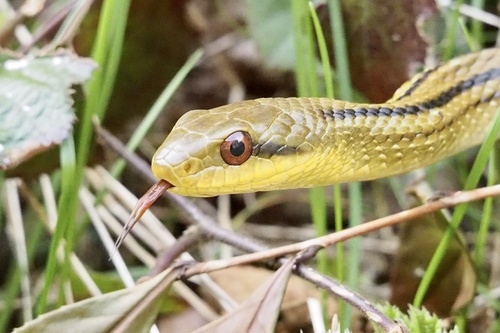
The snakes brumate for three to four months, mate in spring and lay 7–20 eggs in early summer. Adults reach one to two meters in length and about five centimeters in girth. E. climacophora is the largest Japanese snake outside Okinawa. They are variable in color, ranging from pale yellow-green to dark blue-green. They can be identified as Asian rat snakes due to the dark streak behind each of their eyes.

Juveniles have brown-stripe pattern that may be mimesis of the venomous mamushi. There is an established, albino population in the wild, with specimens especially numerous near Iwakuni, where they are called "Iwakuni white snakes" and revered as messengers of deities and deity-guardians of mountains and rivers. The albino population was protected in 1924 as a "national monument."

Japanese rat snakes eat a variety of small animals: rodents... Wikipedia →

Global Distribution

Parks Where Found

# Park Country Daily sighting probability
1 Nikko National Park 🇯🇵 Japan
~30%

More parks will be added in future updates.

Cities Where Found

# City Country Daily sighting probability
1 Nagoya 🇯🇵 Japan
~30%
2 Tokyo 🇯🇵 Japan
~20%
3 Sendai 🇯🇵 Japan
~20%
4 Sapporo 🇯🇵 Japan
~20%
5 Osaka 🇯🇵 Japan
~10%

Zoos & Centres Where Found

# Zoo / Centre Country
1 San Diego Zoo 🇺🇸 United States In captivity
2 Fort Worth Zoo 🇺🇸 United States In captivity
3 Asahiyama Zoo 🇯🇵 Japan In captivity
4 Ueno Zoological Gardens (West Garden) 🇯🇵 Japan In captivity
5 Leningrad Zoo 🇷🇺 Russia In captivity
6 Siam Serpentarium 🇹🇭 Thailand In captivity
7 Snake Farm of Queen Saovabha Memorial Institute 🇹🇭 Thailand In captivity
8 Adachi Park of Living Things 🇯🇵 Japan In captivity
9 AOAO Sapporo 🇯🇵 Japan In captivity
10 Japan Snake Center 🇯🇵 Japan In captivity
11 Snake Discovery: A Reptile Experience 🇺🇸 United States In captivity

Before you go

What are the chances of seeing a Japanese Rat Snake in Osaka?

With luck

About 10% of wildlife watchers report a Japanese Rat Snake sighting in Osaka on a given day, based on 34 verified sightings from GBIF citizen-science data. It is the 7th most-seen of the 12 reptiles we can rate there. Over three days the chance rises to about 30%, and over a week to about 60%, if each day is a fresh chance.

When is the best time to see a Japanese Rat Snake in Osaka?

June

In that month about 30% of wildlife watchers report a Japanese Rat Snake in Osaka on a given day, against under 5% in December to March, the lowest months. That is one of Osaka's wettest months, with about 190 mm of rain against 55 mm in January.

What time of day is best to see a Japanese Rat Snake?

Between 11 am and 2 pm

Across all the parks we cover, that three-hour window holds the most Japanese Rat Snake sightings with a recorded time, and about 8 in 10 of them come between 6 am and 6 pm: it is a daytime animal.

Is Osaka the best place to see a Japanese Rat Snake?

5th of 5

Of the 5 cities where we can rate Japanese Rat Snake sightings, Osaka ranks 5th at about 10%. The best odds are in Nagoya (Japan, about 30%), Tokyo (Japan, about 20%) and Sendai (Japan, about 20%).

Where does the Japanese Rat Snake sighting chance come from?

GBIF citizen-science records

It is estimated from how often the Japanese Rat Snake is recorded against all the reptiles logged in Osaka (34 verified sightings), calibrated against known sighting rates. Figures are rounded to the nearest 10% because citizen-science data supports honest approximations, not decimals, and months with records from fewer than five people show "—". How it works.

← Back to Osaka