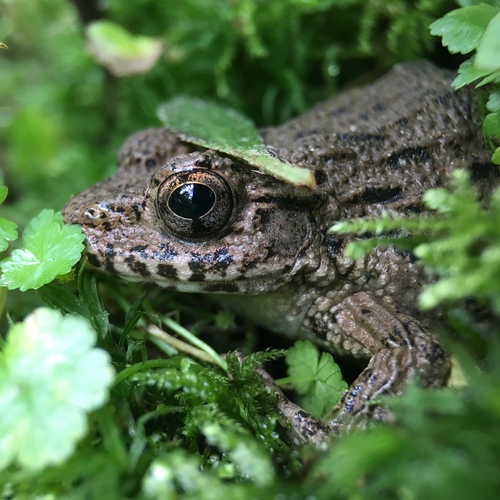
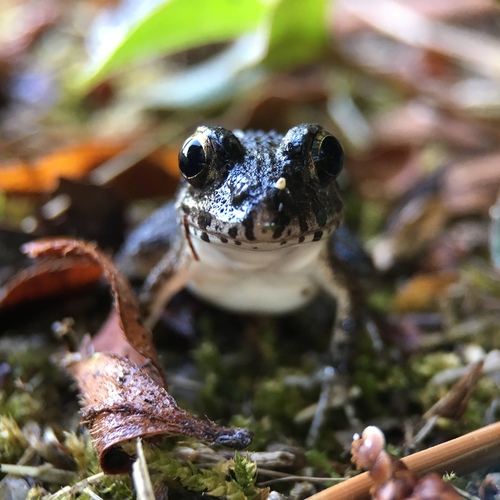
Rice field frog

Rice field frog

Fejervarya kawamurai

LCLeast ConcernNTVUENCR
Daily sighting probability ~10% · With luck
at Osaka

In 3 days ~30% in a week ~50%

23 Verified sightings at Osaka
August Best month
🌅 Crepuscular When it's spotted

About the Rice field frog

Fejervarya kawamurai is a species of frog in the family Dicroglossidae. It is endemic to Taiwan, Japan (Ryukyu Islands and Honshu), and China. It belongs to the Fejervarya limnocharis species complex. F. kawamurai is a relatively small species of paddy frog. Males have a snout-vent length of 36–41 mm, and females are slightly larger at 40–47 mm.

F. kawamurai is widespread species, ranging across central and eastern China, western Taiwan, much of South Korea, and, in Japan, the western part of Honshu, Shikoku, Kyushu, and the Ryukyu Islands, apart from the Sakishima Islands.

It has also recently invaded the Kanto region of Japan. Its presence there was first recorded in 1997, and it may have been accidentally introduced by way of imported soil or crop seeds. There is also speculation that global warming may be enabling its spread to previously unliveable areas.

This species is most commonly found in paddy fields, and rarely ventures into other habitats. This frog lays multiple clutches of eggs during breeding and its tadpoles undergo metamorphosis swiftly after hatching. F. kawamurai‘s breeding season... Wikipedia →
Global Distribution

Parks Where Found

# Park Country Daily sighting probability

More parks will be added in future updates.

Cities Where Found

# City Country Daily sighting probability
1 Nagoya 🇯🇵 Japan
~40%
2 Naha 🇯🇵 Japan
~20%
3 Fukuoka 🇯🇵 Japan
~20%
4 Wuhan 🇨🇳 China
~20%
5 Hangzhou 🇨🇳 China
~10%
6 Nanjing 🇨🇳 China
~10%
7 Osaka 🇯🇵 Japan
~10%
8 Shanghai 🇨🇳 China
~10%
9 Tokyo 🇯🇵 Japan
~10%

Before you go

What are the chances of seeing a Rice field frog in Osaka?

With luck

About 10% of wildlife watchers report a Rice field frog sighting in Osaka on a given day, based on 23 verified sightings from GBIF citizen-science data. It is the 3rd most-seen of the 8 amphibians we can rate there. Over three days the chance rises to about 30%, and over a week to about 50%, if each day is a fresh chance.

When is the best time to see a Rice field frog in Osaka?

August and September

In those months about 20% of wildlife watchers report a Rice field frog in Osaka on a given day, against under 5% in October to March, the lowest months.

What time of day is best to see a Rice field frog?

Between 6 and 9 am

Across all the parks we cover, that three-hour window holds the most Rice field frog sightings with a recorded time, and about 7 in 10 of them come between 6 am and 6 pm: it is most active around dawn and dusk.

Is Osaka the best place to see a Rice field frog?

7th of 9

Of the 9 cities where we can rate Rice field frog sightings, Osaka ranks 7th at about 10%. The best odds are in Nagoya (Japan, about 40%), Naha (Japan, about 20%) and Fukuoka (Japan, about 20%).

Which relatives of the Rice field frog live in Osaka?

Same order: Anura

The closest relatives of the Rice field frog that you can see in Osaka (order Anura, Frogs and Toads) are American Bullfrog (about 20%), Wrinkled Frog (about 10%) and Black-spotted Frog (about 10%), with each one's daily chance of a sighting.

Where does the Rice field frog sighting chance come from?

GBIF citizen-science records

It is estimated from how often the Rice field frog is recorded against all the amphibians logged in Osaka (23 verified sightings), calibrated against known sighting rates. Figures are rounded to the nearest 10% because citizen-science data supports honest approximations, not decimals, and months with records from fewer than five people show "—". How it works.

← Back to Osaka