Daily sighting probability ~10% · With luck
at Perth

In 3 days ~20% in a week ~30%

16 Verified sightings at Perth
November Best month

About the Megachile erythropyga

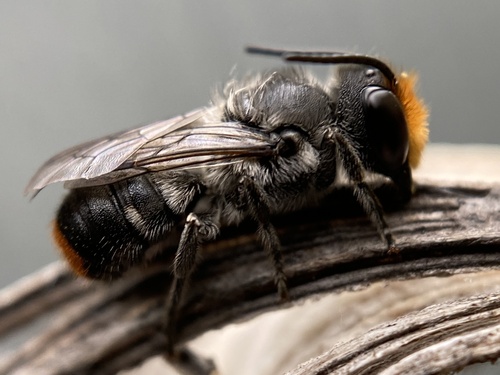
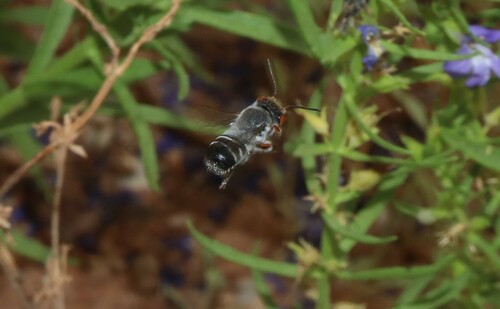
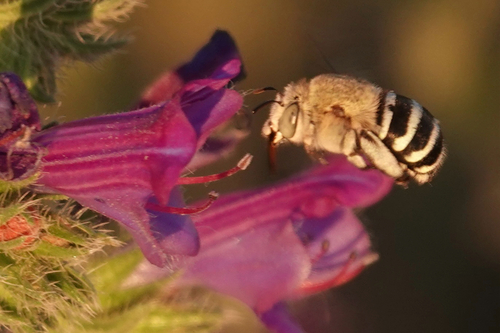
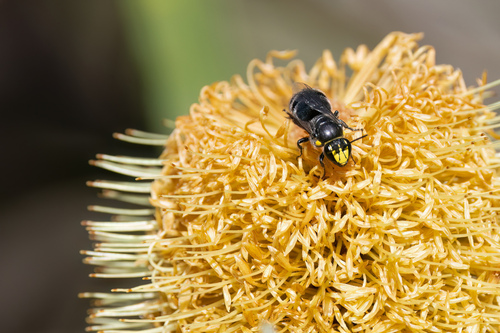
Megachile erythropyga is a species of bee native to southern Australia. A member of the family Megachilidae, it was described in 1853. Males and females both have orange facial hair and an orange hair spot on the end of the abdomen. The male forelegs are unmodified. This species is commonly found using man-made bee hotels, in which it seals each nest with a resin plug.

Megachile erythropyga was described by British entomologist Frederick Smith in 1853. Males are around 10mm long, and females are larger at around 14mm long. Both sexes have bright orange facial hair and an orange spot of hair on the end of the abdomen. There is long white hair on the first abdominal segment and a small patch of white hair on each side of the second segment. The wings are smoky with black veins. The female’s scopal hairs for collecting pollen are a very pale yellow, and located under the abdomen. The forelegs of the male do not have any of the modifications that can be seen on the males of many other Megachile species.

M. erythropyga occurs across southern Australia in the states of Western Australia, South Australia, Victoria, New South... Wikipedia →

Global Distribution

Parks Where Found

# Park Country Daily sighting probability

More parks will be added in future updates.

Cities Where Found

# City Country Daily sighting probability
1 Perth 🇦🇺 Australia
~10%
2 Melbourne 🇦🇺 Australia
<5%

Before you go

What are the chances of seeing a Megachile erythropyga in Perth?

With luck

About 10% of wildlife watchers report a Megachile erythropyga sighting in Perth on a given day, based on 16 verified sightings from GBIF citizen-science data. It is the 127th most-seen of the 275 insects we can rate there. Over three days the chance rises to about 20%, and over a week to about 30%, if each day is a fresh chance.

When is the best time to see a Megachile erythropyga in Perth?

September and November–February

In those months about 10% of wildlife watchers report a Megachile erythropyga in Perth on a given day, against under 5% in March–August and October, the lowest months. Those are among Perth's driest months, with about 30 mm of rain a month against 130 mm in July.

Is Perth the best place to see a Megachile erythropyga?

Yes

Of the 2 cities where we can rate Megachile erythropyga sightings, Perth has the highest daily chance: about 10%. Next come Melbourne (Australia, under 5%).

Where does the Megachile erythropyga sighting chance come from?

GBIF citizen-science records

It is estimated from how often the Megachile erythropyga is recorded against all the insects logged in Perth (16 verified sightings), calibrated against known sighting rates. Figures are rounded to the nearest 10% because citizen-science data supports honest approximations, not decimals, and months with records from fewer than five people show "—". How it works.

← Back to Perth