Bosca's newt

Bosca's newt

Lissotriton boscai

Silhouette: Luca Leicht · PhyloPic

LCLeast ConcernNTVUENCR
Daily sighting probability ~20% · Possible
at Porto

In 3 days ~40% in a week ~70%

84 Verified sightings at Porto
60 In 1 park From 2019 to 2026
February Best month
🌅 Crepuscular When it's spotted

About the Bosca's newt

Boscá's newt (Lissotriton boscai, formerly Triturus boscai), also known as the Iberian newt, is a species of newt in the family Salamandridae. The species is found in Portugal and western Spain. The specific name boscai is in honor of Spanish herpetologist Eduardo Boscá.

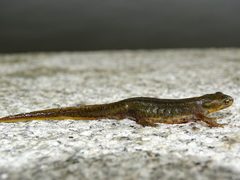
The female is up to 94 millimetres (3.7 in) long and the male up to 75 millimetres (3.0 in). There are glandular ridges along the back and the skin is granular in texture when the newt is living out of water. The body is brownish, yellowish, or dull green with dark spotting. The belly is orange. Unlike some of its congeners, this species is not especially showy during the breeding season. The male develops a brightly colored protuberance at the tip of the tail.

This newt is mostly aquatic, living in shallow ponds and streams lined with vegetation. It can be found in disturbed and artificial water bodies, such as ditches. It is known from oak woodland habitat, scrub, sandy coastal strips, and farms and plantations.

Populations are stable and the species is not considered to be threatened, but in some areas it experiences losses due to... Wikipedia →

Global Distribution

Parks Where Found

# Park Country Daily sighting probability
1 Monfragüe National Park 🇪🇸 Spain
~40%

More parks will be added in future updates.

Cities Where Found

# City Country Daily sighting probability
1 Porto 🇵🇹 Portugal
~20%

Zoos & Centres Where Found

# Zoo / Centre Country
1 Aquarium of Gijón 🇪🇸 Spain In captivity

Before you go

What are the chances of seeing a Bosca's newt in Porto?

Possible

About 20% of wildlife watchers report a Bosca's newt sighting in Porto on a given day, based on 84 verified sightings from GBIF citizen-science data. It is the 3rd most-seen of the 7 amphibians we can rate there. Over three days the chance rises to about 40%, and over a week to about 70%, if each day is a fresh chance.

When is the best time to see a Bosca's newt in Porto?

February and April

In those months about 30% of wildlife watchers report a Bosca's newt in Porto on a given day, against about 10% in May–September and December, the lowest months.

What time of day is best to see a Bosca's newt?

Between 6 and 9 pm

Across all the parks we cover, that three-hour window holds the most Bosca's newt sightings with a recorded time, and about half of them come between 6 am and 6 pm: it is most active around dawn and dusk.

Where else can you see a Bosca's newt?

Only Porto, in our data

Porto is the only city on Wallace's Line with enough records to rate Bosca's newt sightings: about 20% of wildlife watchers there report one on a given day.

Which relatives of the Bosca's newt live in Porto?

Same family: Salamandridae

The closest relatives of the Bosca's newt that you can see in Porto (family Salamandridae, True Salamanders and Newts) are Fire Salamander (about 20%) and Marbled Newt (about 10%), with each one's daily chance of a sighting.

Where does the Bosca's newt sighting chance come from?

GBIF citizen-science records

It is estimated from how often the Bosca's newt is recorded against all the amphibians logged in Porto (84 verified sightings), calibrated against known sighting rates. Figures are rounded to the nearest 10% because citizen-science data supports honest approximations, not decimals, and months with records from fewer than five people show "—". How it works.

← Back to Porto