About the Indian Walking Stick
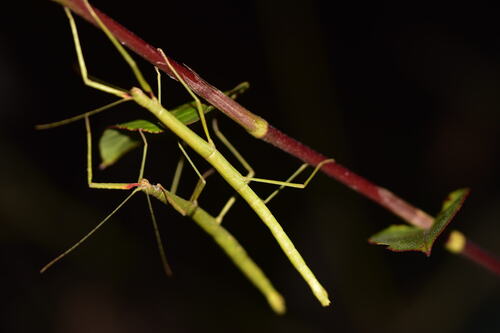
Carausius morosus (the 'common', 'Indian' or 'laboratory' stick insect) is a species of Phasmatodea (phasmid) often kept as pets. Culture stocks originate from a collection from Tamil Nadu, India. Like the majority of the Phasmatodea, C. morosus are nocturnal. Culture stocks are parthenogenetic females that can reproduce without mating. Only 1 in 1000 are male, and although in captivity, gynandromorphs (individuals with both female and male characteristics) are sometimes reared.
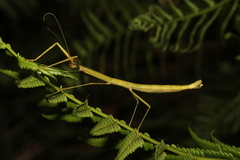
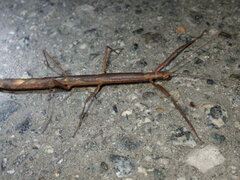
Females are elongated and about 80–100 mm (3–4 in) in length, ranging from a light green to a darkish brown in colour. The front legs have red patches at the base of the forelegs, and similar but yellow patches on the mid-legs. Eggs are 2 mm (0.08 in) in length, ovoid and brown, with a beige capitula at one end.
When the eggs hatch, the plug opens and dark, tiny, string-like young crawl out of the opening. The eggs are haploid. After hatching, the body of the stick insect can sometimes still be attached to the egg, but it is harmless and comes off mostly at the first moult.
When disturbed, the major defence method is feigning death, the body becoming rigid,... Wikipedia →