Common River Frog

Common River Frog

Amietia delalandii

Silhouette: Dmitry Bogdanov (vectorized by T. Michael Keesey) · PhyloPic

LCLeast ConcernNTVUENCR
Daily sighting probability ~30% · Possible
at Pretoria

In 3 days ~60% in a week ~90%

58 Verified sightings at Pretoria
38 In 1 park From 2019 to 2026
January Best month
☀️🌙 Day & Night When it's spotted

About the Common River Frog

Amietia delalandii, also known as the Delalande's river frog, the Drakensberg frog, Drakensberg river frog, or Sani Pass frog, is a species of southern African river frog in the family Pyxicephalidae. It is found in Lesotho, South Africa, Mozambique, Malawi, Zimbabwe, and possibly Zambia. It is the sister species to A. vertebralis.

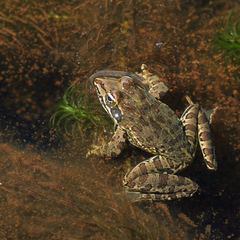
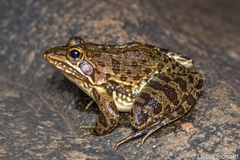
River frogs all have streamlined bodies with pointed noses and live close to water. They have well-developed hind legs and when disturbed rapidly leap into the water, where they may remain submerged for long periods. Males reach a snout–urostyle length 58 mm (2.3 in) and females 83 mm (3.3 in). The toes are partially webbed. The colouration is variable but typically the dorsum ranges from dull brown to luminous green with a pale brown background with orange flecks, and is covered by small dark brown blotches. About half of individuals have a prominent pale vertebral stripe. The tympanum is more than half the diameter of its eye and is dark with pale flecks. The gular area is usually marbled, with the marbling extending to the chest; otherwise, the underside is unmarked and uniformly pale.

The male advertisement call is a short series of... Wikipedia →

Sounds

Advertisement call0:47

South Africa · 2025

© Ruben Foquet · XC1000524 · CC BY-NC-SA 4.0

Recording0:18

South Africa · 2026

© Vincent Egan · iNaturalist · CC BY-NC 4.0

Recording0:46

South Africa · 2022

© Alex Rebelo · iNaturalist · CC BY-NC 4.0

Global Distribution

Parks Where Found

# Park Country Daily sighting probability
1 Kruger National Park 🇿🇦 South Africa
~10%

More parks will be added in future updates.

Cities Where Found

# City Country Daily sighting probability
1 Pretoria 🇿🇦 South Africa
~30%
2 Johannesburg 🇿🇦 South Africa
~20%
3 Harare 🇿🇼 Zimbabwe
~10%
4 Durban 🇿🇦 South Africa
~10%

Before you go

What are the chances of seeing a Common River Frog in Pretoria?

Possible

About 30% of wildlife watchers report a Common River Frog sighting in Pretoria on a given day, based on 58 verified sightings from GBIF citizen-science data. It is the 2nd most-seen of the 5 amphibians we can rate there. Over three days the chance rises to about 60%, and over a week to about 90%, if each day is a fresh chance.

When is the best time to see a Common River Frog in Pretoria?

January

In that month about 50% of wildlife watchers report a Common River Frog in Pretoria on a given day, against under 5% in June and July, the lowest months. That is one of Pretoria's wettest months, with about 120 mm of rain against almost none in July.

What time of day is best to see a Common River Frog?

Between 10 am and 1 pm

Across all the parks we cover, that three-hour window holds the most Common River Frog sightings with a recorded time, and about 6 in 10 of them come between 6 am and 6 pm: it is seen both by day and at night.

Is Pretoria the best place to see a Common River Frog?

Yes

Of the 4 cities where we can rate Common River Frog sightings, Pretoria has the highest daily chance: about 30%. Next come Johannesburg (South Africa, about 20%) and Harare (Zimbabwe, about 10%).

Which relatives of the Common River Frog live in Pretoria?

Same order: Anura

The closest relatives of the Common River Frog that you can see in Pretoria (order Anura, Frogs and Toads) are African Split-skin Toad (about 30%), African Common Toad (about 30%) and Ranger's Toad (about 20%), with each one's daily chance of a sighting.

Where does the Common River Frog sighting chance come from?

GBIF citizen-science records

It is estimated from how often the Common River Frog is recorded against all the amphibians logged in Pretoria (58 verified sightings), calibrated against known sighting rates. Figures are rounded to the nearest 10% because citizen-science data supports honest approximations, not decimals, and months with records from fewer than five people show "—". How it works.

← Back to Pretoria