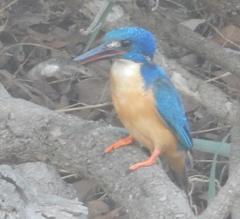
Half-collared Kingfisher

Half-collared Kingfisher

Alcedo semitorquata

Silhouette: Steven Traver · PhyloPic

LCLeast ConcernNTVUENCR
Daily sighting probability <5% · Rare
at Pretoria

In 3 days <5% in a week ~10%

11 Verified sightings at Pretoria
296 In all 4 parks From 2019 to 2026
August Best month
☀️ Diurnal When it's spotted

About the Half-collared Kingfisher

The half-collared kingfisher (Alcedo semitorquata) is a kingfisher in the subfamily Alcedininae that is found in southern and eastern Africa. It feeds almost exclusively on fish and frequents streams, rivers and larger bodies of water with dense shoreline vegetation.

The half-collared kingfisher was described by the English ornithologist William Swainson in 1823 and given its current binomial name Alcedo semitorquata. The word Alcedo is the Latin for a "kingfisher". The specific epithet semitorquata is from the Latin semi- for "half" or "small" and torquatus for "collared". The half-collared kingfisher is one of eight species in the genus Alcedo and is most closely related to the shining-blue kingfisher (Alcedo quadribrachys).

It is known to sometimes vocalize while approaching its nest, but the purpose or advantage of this behavior is unclear. The half-collared kingfisher is a medium-sized kingfisher. It is around 18 cm (7.1 in) in length with a weight of 35–40 g (1.2–1.4 oz). It has blue upperparts, a white throat and pale orange underparts. The head has alternating light blue and dark blue bands running across the crown and each side of the neck has a creamy white... Wikipedia →

Sounds

Call0:11

Zambia · 2026

© Magnus Wadstein · XC1102307 · CC BY-NC-SA 4.0

Song0:23

South Africa · 2021

© Tim Cockcroft · XC645323 · CC BY-NC-SA 4.0

Flight call0:12

Malawi · 2015

© Frank Lambert · XC366425 · CC BY-NC-ND 4.0

Global Distribution

Parks Where Found

# Park Country Daily sighting probability
1 Kafue National Park 🇿🇲 Zambia
~10%
2 Garden Route National Park 🇿🇦 South Africa
~10%
3 Chobe National Park 🇧🇼 Botswana
<5%
4 Kruger National Park 🇿🇦 South Africa
<5%

Cities Where Found

# City Country Daily sighting probability
1 Pretoria 🇿🇦 South Africa
<5%
2 Durban 🇿🇦 South Africa
<5%

Before you go

What are the chances of seeing a Half-collared Kingfisher in Pretoria?

Rare

Under 5% of wildlife watchers report a Half-collared Kingfisher sighting in Pretoria on a given day, based on 11 verified sightings from GBIF citizen-science data. It is the 151st most-seen of the 177 birds we can rate there. Over three days the chance rises to under 5%, and over a week to about 10%, if each day is a fresh chance.

When is the best time to see a Half-collared Kingfisher in Pretoria?

August

In that month about 10% of wildlife watchers report a Half-collared Kingfisher in Pretoria on a given day, against under 5% in September to July, the lowest months. That is one of Pretoria's driest months, with about 5 mm of rain against 130 mm in December.

What time of day is best to see a Half-collared Kingfisher?

Between 9 am and noon

Across all the parks we cover, that three-hour window holds the most Half-collared Kingfisher sightings with a recorded time, and about 9 in 10 of them come between 6 am and 6 pm: it is a daytime animal.

Is Pretoria the best place to see a Half-collared Kingfisher?

Yes

Of the 2 cities where we can rate Half-collared Kingfisher sightings, Pretoria has the highest daily chance: under 5%. Next come Durban (South Africa, under 5%).

Which relatives of the Half-collared Kingfisher live in Pretoria?

Same family: Alcedinidae

The closest relatives of the Half-collared Kingfisher that you can see in Pretoria (family Alcedinidae, Kingfishers) are Brown-hooded Kingfisher (about 10%) and Malachite Kingfisher (about 10%), with each one's daily chance of a sighting.

Where does the Half-collared Kingfisher sighting chance come from?

GBIF citizen-science records

It is estimated from how often the Half-collared Kingfisher is recorded against all the birds logged in Pretoria (11 verified sightings), calibrated against known sighting rates. Figures are rounded to the nearest 10% because citizen-science data supports honest approximations, not decimals, and months with records from fewer than five people show "—". How it works.

← Back to Pretoria