Baird's Patchnose Snake

Baird's Patchnose Snake

Salvadora bairdi

Silhouette: Alex Slavenko · PhyloPic

LCLeast ConcernNTVUENCR Endemic
Daily sighting probability ~10% · With luck
at Puebla

In 3 days ~30% in a week ~60%

10 Verified sightings at Puebla
May Best month
☀️ Diurnal When it's spotted

About the Baird's Patchnose Snake

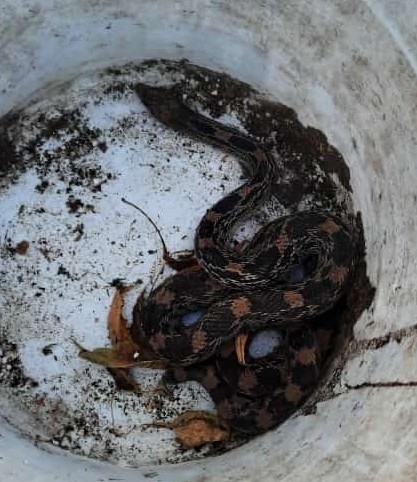
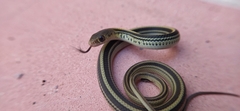
Salvadora bairdi, also known commonly as Baird's patchnose snake and la culebra chata de Baird in Mexican Spanish, is a species of snake in the subfamily Colubrinae of the family Colubridae. The species is native to central Mexico.

The specific name, bairdi, is in honor of American zoologist Spencer Fullerton Baird. S. bairdi is found in the Mexican states of Aguascalientes, southern Chihuahua, Colima, Durango, Guanajuato, Guerrero, Hidalgo, Jalisco, Michoacán, Morelos, Nayarit, Oaxaca, Puebla, Querétaro, Sinaloa, Sonora, and Veracruz.

The preferred natural habitats of S. bairdi are forest and shrubland, at altitudes of 1,200–2,400 m (3,900–7,900 ft), but it has also been found in agricultural areas. In S. bairdi the rostral does not have free edges. The pale vertebral stripe is three dorsal scales wide on the neck, and tapers to one dorsal scale wide on the posterior third of the body.

S. bairdi is terrestrial. S. bairdi preys upon amphibians, small lizards, and small mammals. S. bairdi is oviparous. An adult female may lay one or two clutches per season. Wikipedia →

Global Distribution

Parks Where Found

# Park Country Daily sighting probability

More parks will be added in future updates.

Cities Where Found

# City Country Daily sighting probability
1 Puebla 🇲🇽 México
~10%
2 Mexico City 🇲🇽 México
~10%

Before you go

What are the chances of seeing a Baird's Patchnose Snake in Puebla?

With luck

About 10% of wildlife watchers report a Baird's Patchnose Snake sighting in Puebla on a given day, based on 10 verified sightings from GBIF citizen-science data. It is the 9th most-seen of the 11 reptiles we can rate there. Over three days the chance rises to about 30%, and over a week to about 60%, if each day is a fresh chance.

When is the best time to see a Baird's Patchnose Snake in Puebla?

May

In that month about 30% of wildlife watchers report a Baird's Patchnose Snake in Puebla on a given day, against under 5% in March and September–January, the lowest months.

What time of day is best to see a Baird's Patchnose Snake?

Between 11 am and 2 pm

Across all the parks we cover, that three-hour window holds the most Baird's Patchnose Snake sightings with a recorded time, and about 8 in 10 of them come between 6 am and 6 pm: it is a daytime animal.

Is Puebla the best place to see a Baird's Patchnose Snake?

Yes

Of the 2 cities where we can rate Baird's Patchnose Snake sightings, Puebla has the highest daily chance: about 10%. Next come Mexico City (México, about 10%).

Which relatives of the Baird's Patchnose Snake live in Puebla?

Same family: Colubridae

The closest relatives of the Baird's Patchnose Snake that you can see in Puebla (family Colubridae, Colubrid Snakes) are Lined Tolucan Ground Snake (about 20%) and Mexican Bull Snake (about 20%), with each one's daily chance of a sighting.

Where does the Baird's Patchnose Snake sighting chance come from?

GBIF citizen-science records

It is estimated from how often the Baird's Patchnose Snake is recorded against all the reptiles logged in Puebla (10 verified sightings), calibrated against known sighting rates. Figures are rounded to the nearest 10% because citizen-science data supports honest approximations, not decimals, and months with records from fewer than five people show "—". How it works.

← Back to Puebla