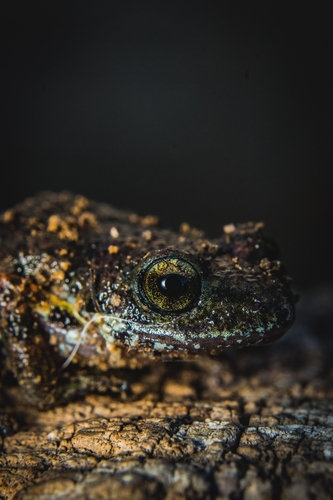
Mexican Spadefoot

Mexican Spadefoot

Spea multiplicata

Silhouette: Jose Carlos Arenas-Monroy · PhyloPic

LCLeast ConcernNTVUENCR
Daily sighting probability ~10% · With luck
at Puebla

In 3 days ~30% in a week ~60%

8 Verified sightings at Puebla
August Best month
🌙 Nocturnal When it's spotted

About the Mexican Spadefoot

The New Mexico spadefoot toad (Spea multiplicata) is a species of American spadefoot toad found in the southwestern United States and Mexico. Like other species of spadefoot toad, they get their name from a distinctive spade-like projections on their hind legs, which enable them to dig in sandy soils. Spea multiplicata can be identified by its wedge-shaped spade. Some sources also refer to the species as the Mexican spadefoot toad, desert spadefoot toad or southern spadefoot toad.

The New Mexico spadefoot toad has a length of 1.5 to 2.5 inches (3.8 to 6.4 cm) with a round body and relatively short legs. They weigh between 1.7 and 3.5 ounces (48 and 99 g). They are green, to grey, to brown, usually reflecting the soil color of their native habitat, often with black and orange colored speckling on their back, and a white underside. They have large eyes, with vertical pupils.

Like all species of spadefoot toad, the New Mexico spadefoot toad is nocturnal and secretive. If handled, these frogs might emit a peanut-like odor, which can cause tearing and nasal discharge if in close contact with the face. Spending most of its time buried in the ground, the spadefoot... Wikipedia →

Sounds

Advertisement call0:13

United States · 2016

© Chris Harrison · XC890937 · CC BY-NC-SA 4.0

Recording0:28

United States · 2021

© K. Greg Murray · iNaturalist · CC BY-NC 4.0

Recording0:18

United States · 2017

Chris · iNaturalist · CC0

Global Distribution

Parks Where Found

# Park Country Daily sighting probability

More parks will be added in future updates.

Cities Where Found

# City Country Daily sighting probability
1 Toluca 🇲🇽 México
~10%
2 Puebla 🇲🇽 México
~10%
3 Guadalajara 🇲🇽 México
~10%
4 Mexico City 🇲🇽 México
<5%

Before you go

What are the chances of seeing a Mexican Spadefoot in Puebla?

With luck

About 10% of wildlife watchers report a Mexican Spadefoot sighting in Puebla on a given day, based on 8 verified sightings from GBIF citizen-science data. Over three days the chance rises to about 30%, and over a week to about 60%, if each day is a fresh chance.

When is the best time to see a Mexican Spadefoot in Puebla?

August

In that month about 30% of wildlife watchers report a Mexican Spadefoot in Puebla on a given day, against under 5% in May, July, September and November–March, the lowest months. That is one of Puebla's wettest months, with about 160 mm of rain against 10 mm in December.

What time of day is best to see a Mexican Spadefoot?

Between 8 and 11 pm

Across all the parks we cover, that three-hour window holds the most Mexican Spadefoot sightings with a recorded time, and about 8 in 10 of them come between 6 pm and 6 am: it is mostly seen at night.

Is Puebla the best place to see a Mexican Spadefoot?

Among the best

Of the 4 cities where we can rate Mexican Spadefoot sightings, Puebla ranks 2nd at about 10%, level with the leaders once rounded. The best odds are in Toluca (México, about 10%).

Which relatives of the Mexican Spadefoot live in Puebla?

Same order: Anura

The closest relatives of the Mexican Spadefoot that you can see in Puebla (order Anura, Frogs and Toads) are Peters' Shiny Peeping Frog (about 20%) and Mountain Treefrog (about 10%), with each one's daily chance of a sighting.

Where does the Mexican Spadefoot sighting chance come from?

GBIF citizen-science records

It is estimated from how often the Mexican Spadefoot is recorded against all the amphibians logged in Puebla (8 verified sightings), calibrated against known sighting rates. Figures are rounded to the nearest 10% because citizen-science data supports honest approximations, not decimals, and months with records from fewer than five people show "—". How it works.

← Back to Puebla