Japanese Peacock Swallowtail

Japanese Peacock Swallowtail

Papilio dehaanii

Daily sighting probability ~10% · With luck
at Qingdao

In 3 days ~30% in a week ~50%

8 Verified sightings at Qingdao
August Best month

About the Japanese Peacock Swallowtail

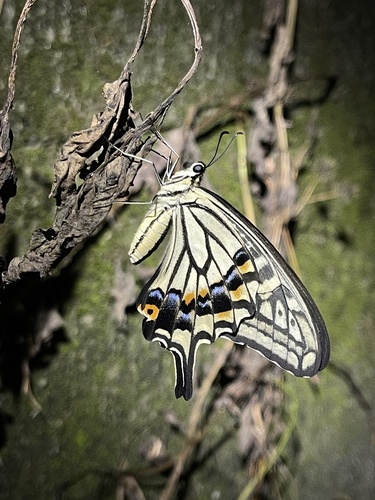
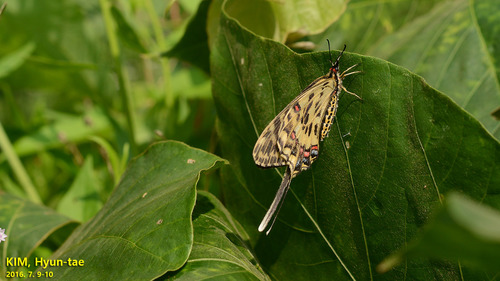
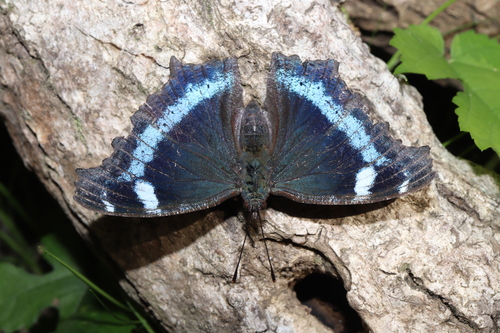
Papilio bianor, also known as the common peacock, is a species of butterfly in the family Papilionidae, the swallowtails. It is native to Continental Asia. It is the state butterfly of the Indian state of Uttarakhand. This species is variable in size. Individuals emerged in the spring reach 4 to 8 centimeters wide, while those emerged in the summer can reach 12 centimeters. The forewings are black with dark veining and green scales. The undersides are brown, turning white distally with dark veining. The hindwings are tailed and have ridged edges containing reddish eyespots. The body is black with green scales.

The male has black hair on the forewings, which the female lacks.. P. bianor. Geographically as well as seasonally very variable. male: the pilose stripes broad, the posterior three usually united, when they are separated the stripe of the lower median remains broader than the interspace, which separates it from the stripe of the submedian fold; upper surface of the forewing dusted with green or greenblue, this scaling commonly condensed into a band before the narrowly dark distal margin; upper surface of the hindwing anteriorly blue... Wikipedia →

Global Distribution

Parks Where Found

# Park Country Daily sighting probability

More parks will be added in future updates.

Cities Where Found

# City Country Daily sighting probability
1 Qingdao 🇨🇳 China
~10%
2 Seoul 🇰🇷 South Korea
~10%
3 Tokyo 🇯🇵 Japan
~10%
4 Osaka 🇯🇵 Japan
<5%

Before you go

What are the chances of seeing a Japanese Peacock Swallowtail in Qingdao?

With luck

About 10% of wildlife watchers report a Japanese Peacock Swallowtail sighting in Qingdao on a given day, based on 8 verified sightings from GBIF citizen-science data. It is the 34th most-seen of the 64 insects we can rate there. Over three days the chance rises to about 30%, and over a week to about 50%, if each day is a fresh chance.

When is the best time to see a Japanese Peacock Swallowtail in Qingdao?

May and July–August

In those months about 20% of wildlife watchers report a Japanese Peacock Swallowtail in Qingdao on a given day, against under 5% in June and October–March, the lowest months. Those are among Qingdao's wettest months, with about 140 mm of rain a month against 10 mm in January.

Is Qingdao the best place to see a Japanese Peacock Swallowtail?

Yes

Of the 4 cities where we can rate Japanese Peacock Swallowtail sightings, Qingdao has the highest daily chance: about 10%. Next come Seoul (South Korea, about 10%) and Tokyo (Japan, about 10%).

Which relatives of the Japanese Peacock Swallowtail live in Qingdao?

Same genus: Papilio

The closest relatives of the Japanese Peacock Swallowtail that you can see in Qingdao (genus Papilio, Common Swallowtails) are Chinese Yellow Swallowtail (about 20%) and Old World Swallowtail (about 10%), with each one's daily chance of a sighting.

Where does the Japanese Peacock Swallowtail sighting chance come from?

GBIF citizen-science records

It is estimated from how often the Japanese Peacock Swallowtail is recorded against all the insects logged in Qingdao (8 verified sightings), calibrated against known sighting rates. Figures are rounded to the nearest 10% because citizen-science data supports honest approximations, not decimals, and months with records from fewer than five people show "—". How it works.

← Back to Qingdao