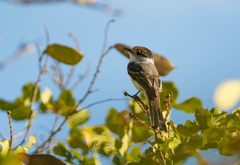
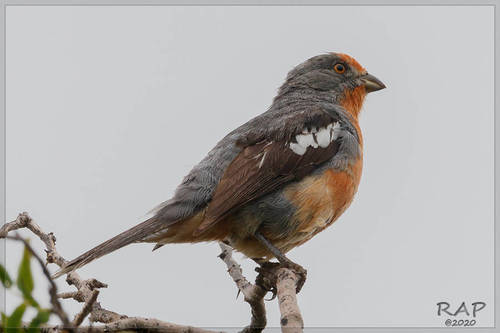
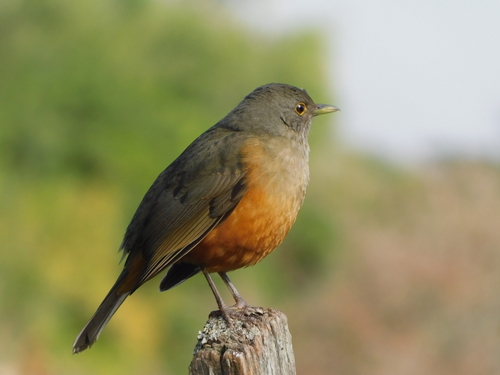
White-naped Xenopsaris

White-naped Xenopsaris

Xenopsaris albinucha

Silhouette: Sheatherius · PhyloPic

LCLeast ConcernNTVUENCR
Daily sighting probability <5% · Rare
at Rosario

In 3 days ~10% in a week ~20%

11 Verified sightings at Rosario
93 In all 2 parks From 2019 to 2026
February Best month
☀️ Diurnal When it's spotted

About the White-naped Xenopsaris

The white-naped xenopsaris (Xenopsaris albinucha), also known as the reed becard and white-naped becard, is a species of suboscine bird in the family Tityridae, the only member of the genus Xenopsaris. It is found in South America, in humid subtropical and tropical savanna climates in most of the countries east of the Andes: Venezuela, Brazil, Bolivia, Paraguay, Uruguay, and Argentina. Living in open woodland and other open forest habitats, it is mostly sedentary, though some populations may be migratory. The species, which is closely related to becards and tityras, was thought to be either a tyrant-flycatcher or cotinga, before it was placed in Tityridae.

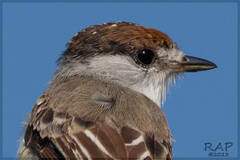
The bird is 12.5 to 13 cm (4.9–5.1 in) in length, with whitish undersides, a black crown, and grey-brown upperparts. The sexes are similar in appearance, though the females have duller upperparts. It feeds on insects in the foliage of trees and bushes, and sometimes on the ground. Nesting occurs in a simple cup nest placed in the fork of a tree. Both parents incubate the eggs and help feed the chicks. When the chicks fledge, the parents may divide up the brood to continue helping. The species is not common and little is known about it, but it is not considered in danger of extinction, and has been classified as of least concern by the International Union for Conservation of Nature. Wikipedia →

Sounds

Call0:33

Brazil · 2022

© Barry Edmonston · XC712968 · CC BY-NC-SA 4.0

Song0:25

Brazil · 2021

© JAYRSON ARAUJO DE OLIVEIRA · XC686624 · CC BY-NC-SA 4.0

Canto0:24

Brazil · 2016

© Caio Brito · XC428146 · CC BY-NC-SA 4.0

Global Distribution

Parks Where Found

# Park Country Daily sighting probability
1 Parque Estadual Encontro das Águas 🇧🇷 Brazil
<5%
2 Iberá National Park 🇦🇷 Argentina
<5%

Cities Where Found

# City Country Daily sighting probability
1 Rosario 🇦🇷 Argentina
<5%
2 Buenos Aires 🇦🇷 Argentina
<5%

Before you go

What are the chances of seeing a White-naped Xenopsaris in Rosario?

Rare

Under 5% of wildlife watchers report a White-naped Xenopsaris sighting in Rosario on a given day, based on 11 verified sightings from GBIF citizen-science data. It is the 105th most-seen of the 121 birds we can rate there. Over three days the chance rises to about 10%, and over a week to about 20%, if each day is a fresh chance.

When is the best time to see a White-naped Xenopsaris in Rosario?

February

In that month about 20% of wildlife watchers report a White-naped Xenopsaris in Rosario on a given day, against under 5% in January, March–September and November, the lowest months. That is one of Rosario's wettest months, with about 140 mm of rain against 20 mm in June.

What time of day is best to see a White-naped Xenopsaris?

Between 7 and 10 am

Across all the parks we cover, that three-hour window holds the most White-naped Xenopsaris sightings with a recorded time, and about 9 in 10 of them come between 6 am and 6 pm: it is a daytime animal.

Is Rosario the best place to see a White-naped Xenopsaris?

Yes

Of the 2 cities where we can rate White-naped Xenopsaris sightings, Rosario has the highest daily chance: under 5%. Next come Buenos Aires (Argentina, under 5%).

Where does the White-naped Xenopsaris sighting chance come from?

GBIF citizen-science records

It is estimated from how often the White-naped Xenopsaris is recorded against all the birds logged in Rosario (11 verified sightings), calibrated against known sighting rates. Figures are rounded to the nearest 10% because citizen-science data supports honest approximations, not decimals, and months with records from fewer than five people show "—". How it works.

← Back to Rosario